
Basement Dehumidification in Youngstown, OH
Think of it this way: waterproofing stops water from getting in; dehumidification removes moisture from the air. They are partners, not substitutes. Running a dehumidifier against an active leak is like bailing a boat with a hole in the hull, technically you are removing water, but you are losing.
Signs you need this service
Humidity problems announce themselves in ways homeowners often misread:
The air feels clammy or heavy
, the basement feels noticeably damper than upstairs, especially in summer
Musty smell
that air fresheners do not fix, the classic sign; the smell is microbial growth fed by moisture
Condensation
on cold water pipes, ductwork, or the lower walls, water beading where warm humid air meets cool surfaces
Rust
forming on the furnace, water heater, tools, or metal shelving near the floor
Dust mites and mustiness
in stored fabrics, fabrics stored in humid basements smell musty within months
Warping or cupping
of wood, shelving, paneling, or trim absorbing moisture
Efflorescence
(white powdery mineral deposits) on walls, proof that moisture is moving through the masonry, even without visible water
A hygrometer reading above 60%
for weeks at a time, the objective measurement; trust the number over your nose
If the basement smells musty every August but seems fine in January, you have a seasonal humidity problem, the most common kind in Youngstown.
What’s included
A proper whole-basement setup is more than a portable unit from a big-box store:
- Humidity assessment , measuring current levels and identifying moisture sources
- Right-sized dehumidifier , a unit rated for your basement's square footage and moisture load (undersized units run constantly and never reach target)
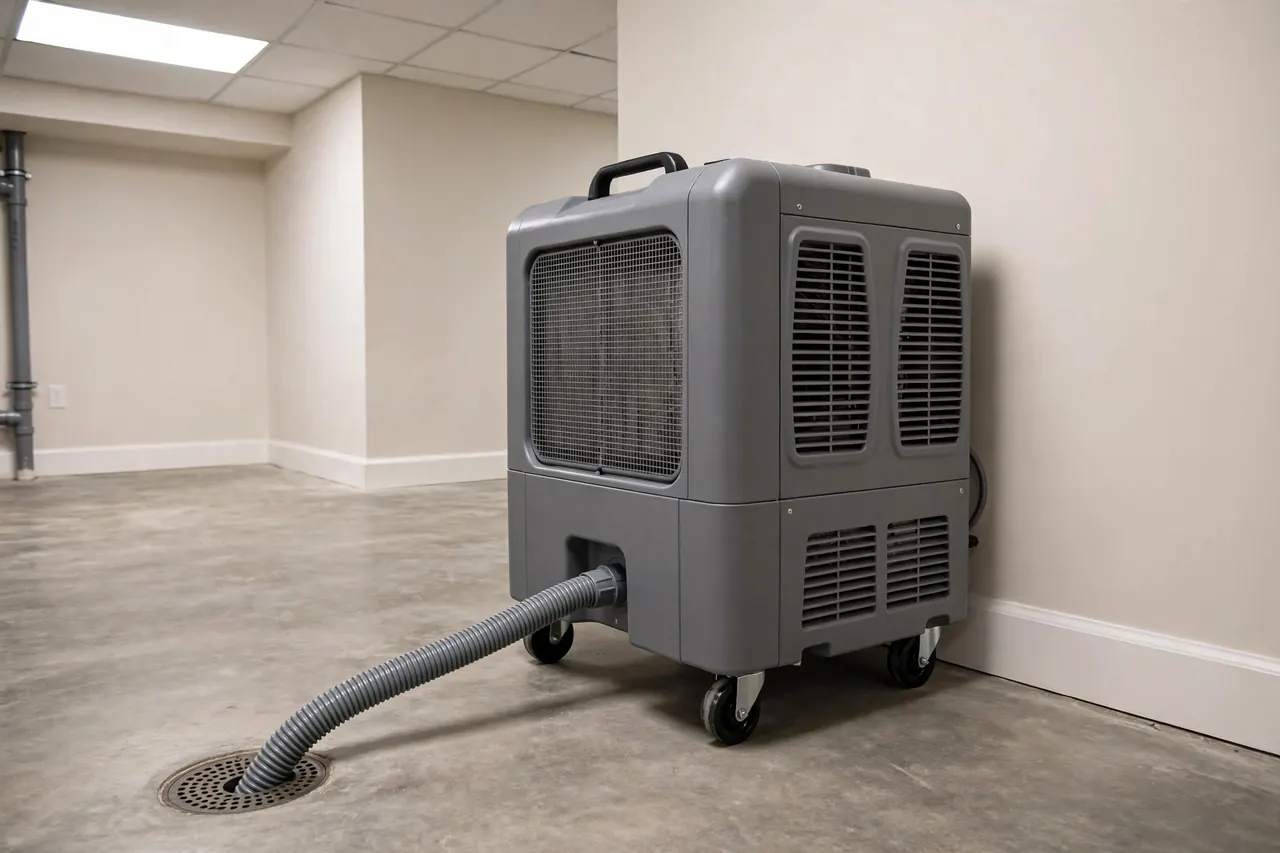
- Drainage for the unit , condensate plumbed to a drain or sump pit, so you are not emptying buckets
- Placement , positioned for good airflow across the whole space, not tucked in a corner
- Humidistat setting , set to your target (usually 45–50%) so it runs automatically
- Integration , coordinated with existing sump pump or drainage systems where present
Portable vs. whole-basement dehumidifiers
Portable units (the $200–$300 box-store type) work for small, mildly damp spaces. Their limits: small tanks you must empty, lower capacity, shorter lifespan, and they struggle in cool basement temperatures.
Whole-basement units are built for the job: higher capacity, drain automatically, operate efficiently at basement temperatures, last longer, and hold a steady humidity level across a full basement. For a genuinely damp Youngstown basement, this is the right tool.
How the work goes
Call (330) 555-0147
Tell us what the basement feels and smells like, and whether water visibly enters.
Assessment
We measure humidity, look for water entry points, and check whether waterproofing is needed first. If water is coming in, we will say so, a dehumidifier alone would be the wrong recommendation.
Sizing and recommendation
We specify the right unit for your basement size and moisture load, plus drainage routing.
Written scope and price
Approved by you before scheduling.
Installation
The unit is placed, leveled, connected to drainage, and set to your target humidity. Most installations take a few hours.
Verification
We confirm it is pulling moisture and holding the target level, and show you the controls and maintenance basics.
Timeline Expectations
- Assessment: one visit, we measure humidity and check for water entry
- Installation: most whole-basement units install in a few hours, placement, drainage connection, humidistat setup
- Results: you should see humidity dropping within the first day of operation; reaching a stable target typically takes a few days as the unit pulls accumulated moisture from the air, walls, and stored materials
- If waterproofing is needed first: the water-entry work is scheduled before or alongside the dehumidifier, running a dehumidifier against an active leak wastes the effort
Will a Dehumidifier Keep My Basement Dry?
It depends on what "wet" means in your basement.
A dehumidifier will handle:
- Damp, clammy air with no visible water entry
- Musty smells from general humidity
- Condensation on pipes, ducts, and walls
- Residual dampness after waterproofing work is complete
- Summer humidity that makes the basement feel like a swamp
A dehumidifier will NOT handle:
- Water flowing in through cracks or the cove joint
- Flooding during heavy rain
- Water wicking up through the slab in sheets
- A failed sump pump or missing drainage
Think of it this way: waterproofing stops water from getting in; dehumidification removes moisture from the air. They are partners, not substitutes. Running a dehumidifier against an active leak is like bailing a boat with a hole in the hull, technically you are removing water, but you are losing.
If you are not sure which one you need, that is exactly what an inspection determines. Call (330) 555-0147.
What Humidity Should a Basement Be?
The widely cited target for basements is 30–50% relative humidity, with most guidance landing around 40–50% as the practical sweet spot.
Why this range matters:
- Above 60%: Mold can grow on organic surfaces. Dust mites thrive. The air feels damp and smells musty.
- 50–60%: Borderline. Some basements sit here naturally in summer; a dehumidifier brings it down.
- 30–50%: The target zone. Dry enough to prevent mold, comfortable, and protective of stored items and finishes.
- Below 30%: Unnecessarily dry for a basement. Can cause static, dry skin, and cracked wood, and wastes energy.
How to know your number: A $15 hygrometer from a hardware store tells you your basement's humidity in seconds. Check it in different seasons, many Youngstown basements are fine in winter and climb past 60% in July and August. If yours sits above 55–60% for weeks at a time, dehumidification is warranted.
Do I Need a Dehumidifier If I Have Waterproofing?
Often, yes, they do different jobs. Waterproofing stops liquid water from entering. But basements still absorb moisture from concrete, from the ground below the slab, and from humid summer air. A waterproofed basement without humidity control can still sit at 60%+ humidity in August.
The complete dry basement has three layers:
- Waterproofing, stops liquid water entry (drainage, pump, crack repair)
- Dehumidification, controls airborne moisture
- Monitoring, a hygrometer and occasional checks to confirm both are working
If you have had waterproofing done and the basement still smells musty, the missing piece is usually dehumidification.
Benefits of Basement Dehumidification
- Mold prevention. Holding humidity below 50% removes the moisture mold needs, the single most effective mold-prevention step after fixing leaks.
- Eliminates musty smells. That basement smell is humidity and microbial growth. Dry the air and it fades.
- Protects belongings. Stored furniture, papers, photos, and fabrics last far longer in dry air.
- Protects finishes. If your basement is finished, drywall, flooring, and trim all suffer in sustained high humidity.
- More comfortable space. A dry basement feels 5–10 degrees more comfortable than a humid one at the same temperature.
- Lower energy costs. Dry air is cheaper to heat and cool, and your HVAC works less hard against basement humidity rising upstairs.
How Dehumidifiers Actually Work (Plain Language)
A dehumidifier is a small refrigeration machine:
- Humid air is pulled in by a fan.
- The air passes over cold coils. Moisture in the air condenses on the cold surface, exactly like water beading on a cold glass in summer.
- The water drips into a collection system, a tank on portable units, or a drain hose on properly installed whole-basement units.
- The now-drier air passes over warm coils, reheating slightly, and is blown back into the room.
The cycle repeats until the air reaches the target humidity set on the humidistat. There are no chemicals and nothing is added to the air, it is condensation, captured and drained away.
Why basement temperature matters: condensation needs the coils to be colder than the air. In cool basements (below about 60°F), cheap portable units ice up, frost forms on the coils and the unit stops working until it defrosts. Whole-basement units are built to operate efficiently at basement temperatures. This is a real, practical difference, not a sales pitch.
Sizing: What "Pints Per Day" Means
Dehumidifiers are rated by pints of water removed per day. Bigger basements and damper conditions need higher capacity:
- Small, mildly damp basement (under ~500 sq ft): lower-capacity units may suffice
- Average basement (500–1,000 sq ft), moderately damp: mid-range capacity
- Large or very damp basement (1,000+ sq ft, or heavy moisture load): high-capacity whole-basement units
Undersizing is the common mistake. An undersized unit runs constantly, never reaches the target humidity, wears out faster, and uses more electricity than a right-sized unit cycling normally. When in doubt, size up, a larger unit running in cycles outperforms a small unit running nonstop.
We size based on your basement's square footage, ceiling height, and measured moisture load, not on a generic chart.
Every Dehumidification Option, With Tradeoffs
Portable units
The $200–$400 box-store type.
Pros: cheap upfront; no installation; fine for small, mildly damp spaces. Cons: small tanks need emptying (or a jury-rigged hose); low capacity; ice up in cool basements; shorter lifespan; noisy.
Whole-basement dehumidifiers
Purpose-built units sized to the space, with automatic drainage.
Pros: right capacity; drains automatically; works at basement temperatures; quieter; longer-lived; holds a steady level automatically. Cons: higher upfront cost; professional installation recommended.
Crawl space dehumidifiers
Compact, low-profile units built for crawl space conditions.
Pros: designed for the tight, cool, damp crawl space environment. Cons: only makes sense as part of crawl space moisture control, see crawl space waterproofing.
HVAC-integrated dehumidification
A whole-house dehumidifier tied into the ductwork.
Pros: controls humidity throughout the house, not just the basement. Cons: higher cost; requires compatible HVAC; overkill if the problem is basement-only.
For most Youngstown basements with real humidity problems, a whole-basement unit with automatic drainage is the right tool. Portables are fine for mild cases, but if you are emptying a tank daily, the unit is telling you it is undersized.
Maintenance: Keeping It Working
A dehumidifier is low-maintenance, not no-maintenance:
- Clean or replace the filter every few months, a clogged filter chokes airflow and kills efficiency
- Check the drain line periodically, condensate lines can clog with slime or freeze in winter where they exit
- Wipe the coils if accessible, dust buildup insulates the coils and reduces moisture removal
- Verify the humidistat with a separate hygrometer once or twice a year, sensors drift; confirm the unit is actually holding your target
- Keep airflow clear, do not box the unit in with storage; it needs room to pull air from across the basement
- Winter check, in unheated basements, confirm the unit is rated for the temperature and not icing up
Ten minutes a few times a year. That is the whole maintenance burden, and it is what separates units that last from units that die young.
Why Youngstown Basements Stay Humid
Clay soil moisture
The Mahoning Valley's clay holds water against foundations year-round. Even without visible leaks, moisture migrates through concrete via capillary action, concrete is porous, and damp soil keeps it damp.
Humid summers
Ohio summers bring weeks of 70%+ outdoor humidity. Basements, being cool, condense that moisture on every surface. An 80-degree humid day outside means a 65-degree basement with water beading on the walls.
High water tables
Near the Mahoning River corridor, groundwater sits close to the slab. The concrete wicks it upward continuously.
Poor ventilation
Basements have little natural airflow. Moisture that enters has nowhere to go, it accumulates until something removes it.
Finished basements trap it
Drywall and flooring over damp concrete hide the moisture while mold grows behind them.
This is why so many Youngstown homeowners say "the basement isn't leaking, it's just damp." That dampness is real, measurable, and fixable, it is just a humidity problem rather than a water-entry problem.
This service is part of our Youngstown basement waterproofing services — the overview ties it all together. See where we work in the Mahoning Valley for the full coverage list.
Why Choose Mahoning Basement Dry Co
We diagnose before we sell
If your problem is water entry, we will tell you a dehumidifier is not the answer, even though it costs us the sale.
Right-sized equipment
We size the unit to your basement and moisture load, not to a commission tier.
Drainage included
No bucket-emptying. Condensate goes to a drain or sump pit as part of the installation.
Paired with waterproofing expertise
When humidity and water entry overlap, and they often do, one company handles both sides coherently.
Written scope, clear price
Approved by you before anything is scheduled.
What affects the cost
These are typical industry estimates, not a quote from us:
- Portable dehumidifier (DIY): $200–$400 for the unit, plus your time emptying it
- Whole-basement dehumidifier, installed with drainage: commonly $1,500–$3,000
- Crawl space dehumidifier (as part of encapsulation): commonly $1,500–$3,000, see crawl space waterproofing
What affects the price: basement size, moisture load, whether drainage plumbing already exists nearby, and the unit's capacity rating. Running cost is modest, typically a few dollars a month in electricity for a modern efficient unit.
When to Call a Pro
Call when:
- Basement humidity stays above 55–60% for weeks (check with a hygrometer)
- Musty smells persist despite cleaning and ventilation
- Condensation is constant on pipes, ducts, or walls
- You have had waterproofing done and the basement still feels damp
- A portable unit runs constantly without reaching target (it is undersized or the moisture load needs professional assessment)
- Water is visibly entering, you may need waterproofing first, and we will tell you
You probably do not need us when:
- Humidity is fine (30–50%) and the basement just smells stale from being closed up, air it out
- A single damp summer week with no pattern, watch it, measure it, call if it persists
Call (330) 555-0147. We will measure your humidity, check for water entry, and recommend only what the basement actually needs.
Serving Youngstown and 10 nearby towns
Common questions
Straight answers about basement dehumidification in Youngstown.
It will control airborne humidity, damp air, musty smells, condensation. It will not stop water entering through cracks, the cove joint, or a failed pump. If water visibly enters, waterproofing comes first.
Aim for 30–50% relative humidity, with 40–50% as the practical target. Above 60% sustained, mold risk rises significantly. A cheap hygrometer tells you where you stand.
Often yes. Waterproofing stops liquid water; humidity from concrete, ground moisture, and summer air remains. Many waterproofed basements still need dehumidification to stay below 50% in summer.
Most whole-basement dehumidifier installations take a few hours, placement, drainage connection, and setup.
The unit's condensate drains through a hose to a floor drain, utility sink, or sump pit. You never empty a bucket, that is part of a proper installation.
Modern whole-basement units are efficient, typically adding only a few dollars a month. An undersized portable unit running constantly can actually cost more to operate than a right-sized whole-basement unit cycling normally.
It depends on square footage, ceiling height, and moisture load. As a rough guide: small mildly-damp basements can use lower-capacity units; average to large or genuinely damp Youngstown basements need high-capacity whole-basement units rated for the space. Undersizing is the most common mistake, we size to your measured conditions during assessment.
In most Youngstown basements, the heavy season is late spring through early fall. Many homeowners run the unit from May through October and find winter air dry enough without it. If your basement stays humid in winter too (common with high water tables), year-round operation makes sense. Let the hygrometer decide, not the calendar.
For mild, small-space humidity, yes. For a genuinely damp full basement, usually not well enough. Portables have small capacity, need manual emptying, ice up in cool basements, and wear out faster running constantly. If you are emptying the tank every day, that is the unit telling you it is undersized for the job.
The coils get too cold relative to the air, common with cheap portable units in cool basements (below ~60°F). Frost blocks airflow and the unit stops dehumidifying until it defrosts. Whole-basement units are designed to operate at lower temperatures without icing. If your unit ices regularly, it is the wrong unit for a basement.
Centrally, with clear airflow around it, not crammed in a corner behind storage. Near a drain or sump pit is ideal for the condensate line. Avoid placing it right against the dampest wall; it needs to circulate air across the whole space to work evenly.
If the smell comes from humidity-fed microbial growth, usually yes, as the air dries and growth conditions disappear. If the smell comes from active mold colonies on materials, the mold needs remediation first (see mold remediation), drying the air alone will not remove established growth.
Related waterproofing services
Fix the Dampness for Good
Damp air, musty smells, and condensation are solvable, with the right diagnosis first. Call Mahoning Basement Dry Co. We will measure your humidity, check for water entry, and recommend only what your basement actually needs: dehumidification, waterproofing, or both.
Call today.