
Interior Drainage Systems in Youngstown, OH
An interior drain system is designed for a specific kind of water problem. You are likely a candidate if:
Signs you need this service
An interior drain system is designed for a specific kind of water problem. You are likely a candidate if:
Water appears along the edge of the basement floor after rain (the cove joint)
Water pushes up through cracks in the concrete slab
One corner of the basement gets wet while the rest stays dry
The basement floor feels damp for days after a storm
Your old sump pit fills up but water still spreads across the floor
You see water stains or efflorescence in a ring around the floor edge
If water pours through wall cracks mid-wall or runs down the walls in sheets, the problem may be different, see foundation crack repair or gutter and downspout services. An inspection tells us which one you have.
What’s included
An interior drainage system is more than a trench in the floor. A complete installation includes:
- Perimeter channel , a drainage channel set into the inside edge of the basement slab, around the full perimeter (or the affected walls)
- Gravel bed , washed stone under and around the channel that lets water flow freely to the drain instead of sitting in soil
- Sump basin and pump , the collection point and the pump that lifts water out of the basement (see sump pump installation)
- Discharge line , pipe that carries pumped water away from the foundation to a safe outlet
- Wall flange or vapor barrier (when needed) , on block walls, a channel that catches water weeping through the wall and drops it into the drain
- New concrete , the floor edge is re-poured and finished over the system
How the work goes
The short version: it gives groundwater an easy path to a pump instead of your floor.
Step 1: Understanding hydrostatic pressure
When it rains, water soaks into the soil around your foundation. In Youngstown's heavy clay soil, water drains slowly, so it builds up against the foundation. That buildup creates pressure, hydrostatic pressure, that pushes water through every weak point: the cove joint (where wall meets floor), cracks in the slab, and porous block walls.
Step 2: The relief channel
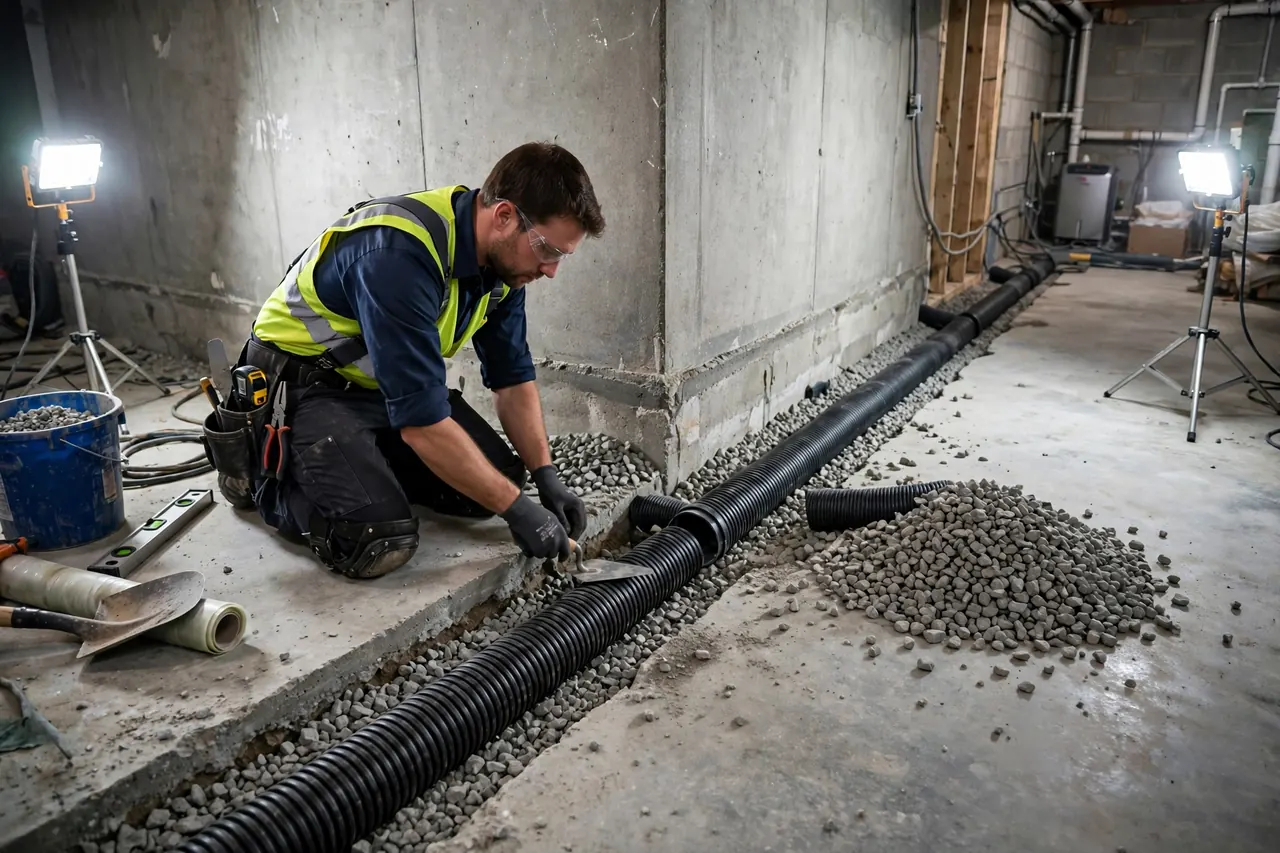
An interior system relieves that pressure. A channel is cut into the basement floor around the inside perimeter, usually 12–18 inches wide. The channel sits at the base of the wall, right where pressure forces water in. A perforated pipe, pipe with small holes along its length, is laid in the channel on a bed of washed gravel. The holes let water in while the gravel keeps soil and silt out of the pipe.
Step 3: Water flows to the sump
Water that would have spread across your floor now drops into the channel instead. The gravel bed around the channel keeps soil out while letting water flow freely. Gravity carries the water along the channel to the sump basin, the lowest point in the system.
Step 4: The pump removes it
When water in the basin reaches a set level, the sump pump turns on and pushes the water up and out through the discharge line, away from the house. The pump shuts off when the basin empties. The cycle repeats automatically every time it rains.
That is the whole system: relieve pressure, collect water, pump it out. No chemicals, no magic, just gravity and a pump.
What about weep holes?
Many Youngstown basements have hollow concrete block walls, and water can sit trapped inside the block cores. During installation, small weep holes are drilled into the lowest course of block at regular intervals. These holes give trapped water a way out, it drains from inside the wall directly into the channel below. Without weep holes, water stays locked in the wall and seeps through slowly for days after every rain.
Timeline Expectations
- Inspection: one visit
- Scheduling: interior work can usually be scheduled within days to a couple of weeks, depending on season
- Installation: one to three days for most basements; finished basements or large footprints can take longer
- Concrete curing: the new concrete edge needs time to cure before heavy use, we will tell you when it is ready
- First-rain check: the real test comes with the next heavy rain; we explain what to watch for
Winter is fine for interior work. Frozen ground outside does not affect anything happening inside your basement.
Interior vs. Exterior Waterproofing, Which Is Better?
This is the most common question we hear, and the honest answer is: it depends on your house.
Choose interior when:
- Water comes through the cove joint, floor cracks, or weeps through block walls
- You want the problem solved without tearing up the yard
- The budget matters, interior systems typically cost about half of exterior excavation
- It is winter and the ground is frozen (interior work can be done year-round)
Choose exterior when:
- The outside of the foundation wall is damaged and needs repair from outside
- You are already excavating for another reason (an addition, a new patio)
- A structural engineer has recommended exterior repair
The combination most homes get: exterior surface fixes (grading, gutters, downspout extensions) plus an interior drainage system for the groundwater. This covers both water sources without the cost of digging around the whole house. Our basement waterproofing page compares both approaches in detail.
Benefits of an Interior Drainage System
- Stops cove-joint and floor seepage, the most common basement water problem in this area
- Works in any season, installed from inside, so frozen ground is not an obstacle
- No yard destruction, no excavation, no torn-up landscaping, no heavy equipment outside
- Handles high water tables, designed exactly for the pressure that pushes water up through slabs
- Fast installation, most systems are installed in one to three days
- Maintainable, the sump basin gives you one visible point to check, and the system can be flushed and inspected
Types of Interior Drainage Systems
Not all interior drains are the same. Here are the main approaches, with honest tradeoffs:
Full-perimeter drain tile
The channel runs around the entire inside perimeter of the basement. This is the standard recommendation when water enters at multiple points or the water table is high.
Pros: handles water from any direction; one complete system. Cons: highest cost of the interior options; more concrete work.
Partial system (one or two walls)
The channel runs only along the walls where water enters. This works when the problem is clearly localized, one leaking wall, one wet corner.
Pros: lower cost; less disruption. Cons: if water later appears on another wall, that wall needs its own work.
Wall flange / baseboard channel
On block walls that weep through their faces, a flange or baseboard channel is attached at the wall base to catch water running down the wall and drop it into the drain. Some systems sit on top of the floor edge (baseboard style) rather than beneath it.
Pros: catches wall seepage directly; baseboard styles avoid deep concrete cutting. Cons: baseboard channels sit visible along the wall base; may not handle heavy floor-level inflow as well as a sub-floor system.
What we recommend
We size the system to what your basement shows us. A full perimeter on a basement that leaks at one corner is overselling. A partial system on a basement with water on three walls is underselling. The inspection decides, and we will explain the reasoning.
The Installation, Step by Step
Here is the granular version of what happens during a typical full-perimeter installation:
- Protection. Floors, stairs, and nearby belongings are covered. Dust control is set up, concrete cutting is dusty work.
- Layout. The channel path is marked around the perimeter, and the sump basin location is chosen at the low point (or where water already collects).
- Concrete cutting. The floor edge is cut, typically 12–18 inches wide, around the marked perimeter. In finished basements, flooring and lower wall sections are handled first.
- Trenching. Soil is removed from the trench down to the footing level, exposing the base of the wall.
- Weep holes (block walls). Small holes are drilled in the lowest course of block so trapped water inside the wall cores can drain into the channel.
- Gravel bed. Washed stone is laid in the trench. This is the filter, water passes through, soil and silt stay out.
- Perforated pipe. The drain pipe (holes facing down, so water enters from below) is laid in the gravel with a slight pitch toward the sump basin.
- Sump basin set. The basin is placed, connected to the channel, and the pump is installed with its float switch and check valve.
- Discharge line. Pipe is run from the pump up and out of the house to a discharge point well away from the foundation.
- Concrete repour. The trench is backfilled with gravel and the floor edge is re-poured with new concrete, finished to match the surrounding slab as closely as possible.
- Wall flange (if needed). On weeping block walls, the flange is attached to direct wall water into the channel.
- Testing and cleanup. The pump is run through full cycles with water. Debris is removed and the work area is cleaned.
Most of this happens in one to three days. You can stay in the house, the work stays in the basement.
Why Youngstown Homes Need This
Interior drainage systems are especially common in the Mahoning Valley for three reasons:
Clay soil holds water
Youngstown-area clay drains slowly, so water sits against foundations after rain and snowmelt. That sitting water is exactly what creates hydrostatic pressure at the cove joint.
Freeze-thaw opens the weak spots
Each winter, freezing soil expands and presses against foundation walls; each spring, the meltwater looks for the same entry points. Over decades, the cove joint and slab cracks become reliable leak paths.
Aging drain tile
Many Youngstown homes were built in the 1940s–1970s with exterior drain tile. After 50+ years, that tile is often clogged with silt or collapsed. When the original exterior system fails, an interior system is the practical replacement, without digging up the yard.
Homes in Boardman, Austintown, and Warren see these patterns constantly because of the same soil and same-era housing stock.
Not sure where to begin? Mahoning Basement Dry Co walks through the whole process. We do this work across the towns we serve around Youngstown.
Youngstown Homes and Interior Drainage: More Local Detail
A few Mahoning Valley specifics worth knowing:
Clay soil is the reason this system is so common here
Sandy soil drains; clay holds. Youngstown's clay keeps water pressed against foundations for days after rain, which is exactly the condition interior drainage is designed to relieve.
Mid-century block foundations
, the dominant type in 1950s–1970s Youngstown-area homes, weep through their hollow cores. The weep-hole step in our process exists largely because of these walls.
Original exterior drain tile has often failed
If your home is 50+ years old and never had drainage work, the buried exterior tile is likely clogged or collapsed. Interior drainage is the practical replacement without excavation.
Neighborhoods near the Mahoning River
and low-lying areas deal with higher water tables, which means more water reaching the system more often, and makes pump reliability (and battery backup) especially important.
Why Choose Mahoning Basement Dry Co
We do basement water work, nothing else
Drainage, pumps, cracks, and moisture are our entire focus.
We size the system to your problem
Not every basement needs a full perimeter. If one wall is the problem, we will tell you.
Written scope before work starts
You approve exactly what gets installed, where, and what it costs.
We check the easy stuff first
Bad grading and short downspouts cause a surprising number of "drainage problems." If yours is one of them, we will say so.
Local experience
We install these systems in Youngstown's clay soil and older homes regularly. We know what works here.
What affects the cost
These are typical industry estimates, not a quote from us. Final cost depends on basement size, foundation type, and how much of the perimeter needs the system.
- Full perimeter interior drainage with sump pump: commonly $4,000–$12,000
- Partial system (one or two walls): commonly $2,000–$5,000
- Sump pump replacement within the system: commonly $500–$2,500
What drives the number up: larger basements, finished basements (flooring and walls must be handled carefully), and block walls that need a wall flange. What keeps it down: a smaller footprint and an existing working sump pit that can be reused.
Anyone who gives you a price over the phone without seeing the basement is guessing. We inspect first, then give you a written scope.
When to Call a Pro
Call us when:
- Water repeatedly appears along the wall-floor joint or through floor cracks
- Your old sump pit fills but water still spreads across the floor
- A previous drainage attempt (a shallow channel, a surface fix) is not working
- You are finishing the basement and want the water handled before drywall goes up
This system is probably not your fix when:
- Water pours through mid-wall cracks (that is a crack repair or structural question, see foundation crack repair)
- Water comes from a sewer backup (different problem, different solution)
- The only water source is a window well (see egress windows and gutters)
Call (330) 555-0147 and describe the pattern. The pattern tells us the system.
Serving Youngstown and 10 nearby towns
Common questions
Straight answers about interior drainage systems in Youngstown.
A channel is cut into the basement floor around the inside perimeter. Groundwater that would push up through the floor or cove joint drops into the channel instead, flows through a gravel bed to a sump basin, and a pump pushes it out of the house. It relieves hydrostatic pressure instead of fighting it.
For most Youngstown homes with cove-joint or floor seepage, interior drainage is the practical choice, less expensive, no excavation, works year-round. Exterior excavation is right when the outside of the wall itself needs repair. An inspection determines which one your situation calls for.
It stops the most common causes: seepage through the cove joint, floor cracks, and weeping block walls. It cannot fix water pouring over a failed window well or a sewer backup, those need different solutions, and we will tell you if that is what you have.
Most interior systems take one to three days of work, depending on basement size. You can stay in the house, the work is contained to the basement.
Yes. The drain collects the water; the pump removes it. The two are one system. A battery backup pump is worth considering in areas with frequent outages, see sump pump installation.
The pump needs power. If the power goes out during a storm, a standard pump stops. That is why we recommend battery backup systems, especially in neighborhoods where outages are common during heavy weather.
The channel and pipe have no moving parts and can last for decades. The sump pump is the wear item, expect to replace it every 7–10 years. Keeping the discharge line clear and testing the pump a few times a year is what protects the system's lifespan.
Yes, but finished walls and flooring complicate the job. Lower wall sections may need to be opened and flooring removed along the perimeter, then restored afterward. This adds cost and time. If you are planning to finish the basement, do the drainage first, it is far cheaper and cleaner that way.
Yes. All the work happens inside the basement, so frozen ground is irrelevant. Winter is actually a fine time to schedule, the only downside is you may wait until spring rains to see the system's first real test.
Some. Test the pump every few months by pouring water into the pit. Keep the pit clear of debris. Make sure the discharge line is not frozen, clogged, or dumping water against the house. Check that the check valve is working (no water rushing back into the pit when the pump stops). That is most of it.
Related waterproofing services
Get Your Basement Inspected
If water keeps appearing along your basement floor edge, an interior drainage system is probably the answer, but the inspection comes first. Call Mahoning Basement Dry Co. We will look at your basement, explain what is causing the water, and give you a written scope with an exact price. No pressure, no guessing.
Call today.