
Foundation Repair in Youngstown, OH
Walk through your basement and look for these:
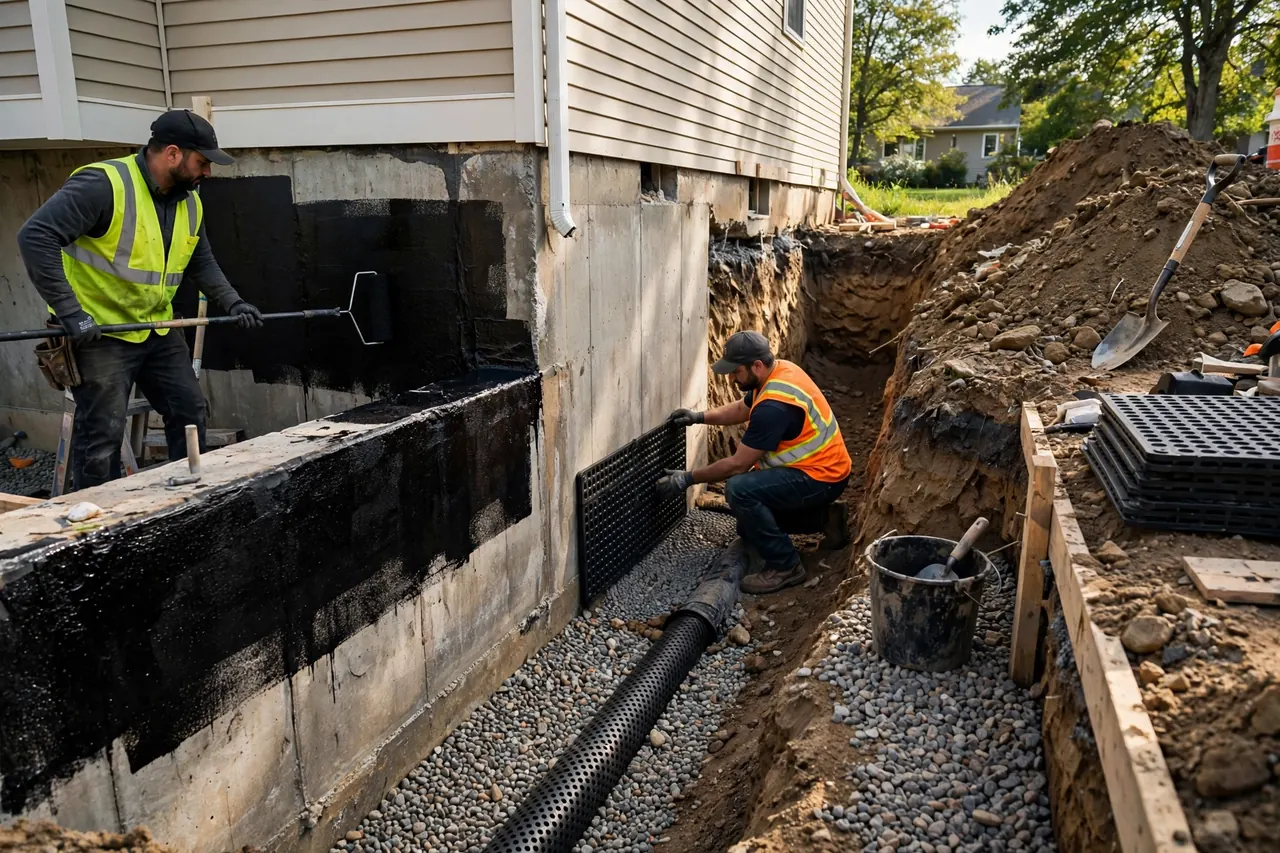
Signs you need this service
Walk through your basement and look for these:
Bowing walls
, basement walls curving inward, sometimes visibly, sometimes only noticeable with a straightedge
Horizontal cracks
, running along the length of a wall, often at the frost line or mid-wall
Stair-step cracks
, zigzag cracks following mortar joints in block walls
Wide vertical cracks
, wider than about 1/4 inch, or cracks that are growing over time
Wall displacement
, one section of wall pushed in further than the section next to it
Sticking doors and windows
, frames shifting as the foundation moves
Uneven or sloping floors
, especially new slopes that were not there before
Gaps
, between the wall and ceiling, or between exterior walls and window frames
Chimneys pulling away
, separation between the chimney and the house wall
One thin vertical crack is usually shrinkage, see foundation crack repair. The signs above, especially in combination, point to movement that needs professional evaluation.
How the work goes
Call (330) 555-0147 and describe what you see
Bowing? Cracking? Sticking doors? Tell us everything.
Inspection
We look at the walls, measure any bowing or displacement, and check for water entry.
Honest triage
If it looks structural, we tell you to get a structural engineer's evaluation, and we explain what to ask the engineer. If it is a waterproofing problem (leaking cracks, water pressure), we handle it.
Written scope
For our work, you get a clear written description and price before scheduling.
Coordination
If an engineer prescribes a repair and waterproofing is part of the plan, we do our part and coordinate sensibly with the other work.
Timeline Expectations
- Engineer evaluation: typically scheduled within days to a couple of weeks; the visit itself is usually under two hours
- Wall anchors / beams / straps: commonly one to three days of installation, plus months of gradual tightening for anchors
- Piering: commonly two to five days depending on pier count
- Exterior excavation: one to three weeks
- Our waterproofing-side work: scheduled to coordinate, often after structural work is complete, so drainage is not disturbed
Structural work is not rushed. If a contractor pressures you to sign the same day as the inspection, slow down and get the engineer's opinion first.
Do I Need a Structural Engineer?
Yes, if you see any of these: horizontal cracking, bowing walls, displacement, or cracks that are actively growing. A structural engineer evaluates whether the foundation is stable, what is causing the movement, and what repair method is appropriate. That evaluation is the foundation (so to speak) of any honest repair plan.
Why we insist on this: A contractor who both diagnoses structural problems and sells the fix has a conflict of interest. An independent engineer has no repair to sell you, just an assessment. We will happily do the waterproofing work that follows an engineer's plan, and we will tell you directly when an engineer should go first.
When an engineer is probably not needed: thin, stable vertical cracks with no displacement and no water, these are typically handled with standard crack repair.
General Foundation Repair Methods (Explained Plainly)
These are the methods commonly used for foundation wall and settlement problems. We describe them so you can understand an engineer's recommendation, not as a catalog of things we claim to do.
Wall anchors
Steel plates are placed against the inside of the bowing wall, connected by rods to anchors buried in stable soil outside. Tightening the system gradually pulls the wall back toward its original position over time. Used for bowing walls where exterior soil conditions allow anchor placement.
Carbon fiber straps
High-strength carbon fiber strips are bonded vertically to the inside of the wall. They prevent further bowing but do not straighten a wall that has already moved significantly. Best for walls in early stages of movement.
Steel I-beams
Vertical steel beams are installed against the inside of the wall, braced between the floor and the joists above. They stabilize the wall and prevent further inward movement. A common solution for bowing block walls.
Piering (for settlement)
When a foundation is sinking, not bowing, steel piers are driven down to stable soil or bedrock and the foundation is lifted or stabilized on them. This addresses vertical settlement, which is a different problem from lateral wall pressure.
Exterior excavation and wall straightening
In severe cases, the wall is excavated from outside, straightened, reinforced, and waterproofed. This is the most disruptive and expensive option, reserved for walls that other methods cannot address.
Important: We describe these methods for your understanding. The right method for your foundation is determined by a structural engineer's evaluation, not by a website, and not by a contractor's preference.
What We Do: The Waterproofing Side
While structural repair belongs to engineers and specialized foundation contractors, water is almost always part of the story, and that is our work:
- Sealing leaking cracks, foundation crack repair stops water at entry points
- Interior drainage systems, drainage relieves the hydrostatic pressure that pushes on walls
- Sump pumps, pumps remove the water that drainage collects
- Gutter and grading corrections, exterior water management reduces the soil saturation driving the pressure
- Dehumidification, humidity control for the damp air that remains
In many cases, controlling water slows or stops further foundation movement, saturated clay is the engine, and drying it out removes the fuel. We handle that side honestly and leave structural work to structural professionals.
Reading Your House: Early Warning Signs in Plain Language
Foundation movement announces itself in the living space before most people check the basement. Watch for:
- Cracks above doors and windows, diagonal cracks running from the corners of door and window frames, especially on the upper floors
- Nail pops and drywall seams opening, walls shifting enough to push fasteners out or split taped joints
- Trim and molding gaps, baseboards or crown molding pulling away from the wall, or gaps appearing around window and door casings
- The marble test, set a marble on a hard floor. If it consistently rolls to the same spot, the floor is sloping. (Carpet hides this; check where you can.)
- Doors that used to close, a door that suddenly sticks, rubs, or will not latch has a frame that moved
- Cracks in brick or exterior siding, stair-step cracks in brick veneer or gaps in siding courses mirror what is happening to the foundation
- Porch or steps pulling away, separation between the porch slab or steps and the house wall
Any one of these alone might be minor. Several together, especially appearing or worsening over a year or two, deserve professional eyes.
What Makes Foundations Move: The Causes in Detail
- Expansive clay soil. The headline cause in the Mahoning Valley. Clay absorbs water and swells with enormous force, then shrinks as it dries. This seasonal push-pull works foundation walls inward a fraction of an inch at a time. After decades, fractions become inches.
- Hydrostatic pressure. Water pooled in soil against the foundation does not just leak in, it pushes continuously. The deeper the water table against the wall, the greater the force.
- Poor drainage and grading. Gutters dumping at the foundation and soil sloping toward the house keep the surrounding soil saturated, maximizing both clay expansion and hydrostatic pressure. This is the cause you can actually fix cheaply.
- Plumbing leaks. A slow leak under or near the foundation washes out soil or keeps it saturated in one spot, causing uneven settlement.
- Tree roots. Large trees near the house drink enormous amounts of water from the soil, causing localized shrinkage, or roots physically press against walls. Removing a mature tree can also cause the soil to rebound.
- Poor original compaction. Some lots were not properly compacted before construction, or fill soil was used. The foundation settles unevenly as the soil consolidates over decades.
- Freeze-thaw. Each winter, water in the soil freezes and expands against the wall; each spring it releases. Older walls accumulate this stress year after year.
Notice how many of these involve water. That is why our waterproofing work matters even when the structural repair belongs to someone else, drying out the soil removes the engine driving the movement.
Foundation Repair Methods: The Full Picture
We describe these so you can understand an engineer's recommendation. The right method is determined by evaluation, not by this page.
Wall anchors
Steel plates inside against the wall, connected by rods to earth anchors buried in stable soil outside. Tightening gradually pulls the wall back over months.
Pros: can actually straighten a bowed wall over time; installed with minimal interior disruption. Cons: needs suitable soil outside for the anchors; requires yard excavation for anchor placement; not usable where there is no exterior access.
Carbon fiber straps
High-strength carbon fiber strips bonded vertically to the wall interior with epoxy.
Pros: clean, low-profile, no excavation; good for early-stage movement. Cons: prevents further bowing but does not straighten a wall that has already moved; not for severe displacement.
Steel I-beams
Vertical steel beams braced between the basement floor and the joists above, tight against the wall.
Pros: strong, immediate stabilization; works on badly bowed block walls. Cons: beams are visible and take up floor space; does not straighten the wall, only stops further movement.
Helical piers
Steel shafts with helical plates screwed into stable soil or bedrock beneath the foundation, then used to support or lift settled sections.
Pros: can be installed in tight spaces with smaller equipment; load-tested during installation. Cons: cost; requires engineering to place correctly.
Push piers
Steel piers hydraulically driven down to bedrock or load-bearing strata, using the house's weight as resistance.
Pros: strong support for settling foundations; can lift settled sections. Cons: heavy equipment; effectiveness depends on reaching suitable bearing soil, depth varies by lot.
Slab jacking / mudjacking vs. polyurethane foam (for settled slabs)
For sunken concrete slabs (porches, garage floors, not foundation walls), material is injected beneath to lift the slab. Mudjacking uses a cement slurry; polyurethane foam uses expanding foam.
Pros of foam: lighter, smaller holes, faster cure. Pros of mudjacking: lower material cost for large voids. Cons of both: does not fix the soil cause; slabs can re-settle if the underlying issue continues. These are for flatwork, not for foundation walls.
Exterior excavation and rebuild
For severe cases: excavate, straighten or rebuild the wall section, waterproof, backfill.
Pros: the most complete correction. Cons: the most disruptive and expensive; heavy equipment; landscaping destroyed.
The order that protects you: engineer evaluates → engineer specifies the method → qualified contractor executes → we handle the waterproofing side (drainage, sealing, water management) that keeps the repair dry. Never let the company selling the repair be the only one diagnosing the problem.
Why Foundations Move in Youngstown
Understanding the cause helps you understand the fix:
Clay soil expansion
Youngstown's clay soil absorbs water and expands, pressing against foundation walls with tremendous lateral force. When it dries, it shrinks back. This cycle, repeated over decades, is the number one driver of bowing walls in the Mahoning Valley.
Hydrostatic pressure
Water building up in soil against the foundation does not just leak in, it pushes. Over time, that pressure moves walls.
Freeze-thaw
Frozen soil expands against walls each winter. Each cycle adds stress, and older walls accumulate the damage.
Poor drainage
When gutters dump water next to the foundation and grading slopes toward the house, the soil stays saturated, maximizing both pressure and expansion.
Original construction
Some mid-century foundations were built with minimal reinforcement by today's standards. They have simply reached the age where movement shows.
For the full picture, start with basement waterproofing in Youngstown. This service is available throughout our Youngstown-area service towns.
Why This Matters in Youngstown Specifically
Expansive clay
The Mahoning Valley's clay is the textbook soil for bowing walls. It swells dramatically when wet and shrinks when dry, working walls inward a fraction of an inch at a time, year after year.
Wet cycles
Lake-effect precipitation and wet springs keep soil saturated for long stretches, exactly when clay exerts maximum pressure.
Mid-century construction
Much of Youngstown's housing stock went up in the 1940s–1970s. Block foundations from that era, now 50–80 years old, are in the prime age range for bowing and stair-step cracking.
Freeze-thaw
Every winter adds another expansion cycle against already-stressed walls.
Homeowners in Boardman, Austintown, and Poland with block foundations should check their walls periodically, a straightedge against the wall once a year takes thirty seconds and catches bowing early.
Why Choose Mahoning Basement Dry Co
We know our lane
Waterproofing is our work. Structural engineering is not, and we will not pretend otherwise to win a job.
Honest triage
We will tell you whether you are looking at a water problem, a structural problem, or both, and who should handle each part.
We handle the water side well
Drainage, pumps, crack sealing, and exterior water management are our daily work.
No scare tactics
A bowing wall is serious, but it is also repairable. We explain options calmly and let you decide.
Written scope, clear price
For any work we do, you approve exactly what and what it costs first.
What affects the cost
These are typical industry estimates for foundation repair work generally, not a quote from us. Structural repair pricing varies enormously by method and severity:
- Carbon fiber straps: commonly $400–$800 per strap installed
- Wall anchors: commonly $600–$1,200 per anchor
- Steel I-beams: commonly $600–$1,000 per beam
- Piering: commonly $1,000–$3,000 per pier
- Full wall stabilization projects: commonly $5,000–$20,000+ depending on scope
Our waterproofing-side work (crack sealing, drainage, pumps) is priced separately, see those pages for typical ranges. Never accept a structural repair quote from someone who has not measured the wall movement. And get an engineer's opinion before committing to major structural work, it is the cheapest insurance in this process.
When to Call Whom
Call a structural engineer first when:
- Walls are bowing, leaning, or displaced
- Cracks are horizontal or growing
- Multiple signs are appearing together (sticking doors + sloping floors + wall cracks)
Call us (Mahoning Basement Dry Co) when:
- Water is entering through cracks or the cove joint
- You need drainage, sump, or exterior water management as part of the plan
- An engineer has prescribed a repair and waterproofing is in the scope
- You are unsure which professional you need, we will triage honestly and point you the right way
What to ask the engineer: What is causing the movement? Is the foundation currently stable? Which repair method do you recommend and why? What happens if I do nothing for a year? A good engineer answers all four plainly.
Serving Youngstown and 10 nearby towns
Common questions
Straight answers about foundation repair in Youngstown.
Bowing walls, horizontal cracks, stair-step cracks in block walls, wide or growing vertical cracks, sticking doors and windows, sloping floors, and gaps around frames. One thin stable vertical crack is usually just shrinkage.
Common methods include wall anchors, steel I-beams, and carbon fiber straps, the right choice depends on how far the wall has moved and the soil conditions. A structural engineer determines which method fits your situation.
For horizontal cracks, bowing, displacement, or growing cracks, yes. For thin, stable vertical cracks with no movement, usually not; standard crack repair handles those. When in doubt, an engineer's evaluation is worth it.
Yes, water is one of the main causes. Saturated clay soil expands and pushes walls inward; hydrostatic pressure stresses foundations continuously. Controlling water with drainage and exterior management removes a major driver of movement.
It varies widely: commonly $400–$1,200 per anchor/beam/strap for wall stabilization, $1,000–$3,000 per pier for settlement, and $5,000–$20,000+ for full projects. These are typical industry estimates, get an engineer's assessment and written quotes before committing.
No, waterproofing does not straighten walls. But it addresses the water pressure and soil saturation that cause and worsen bowing. The honest approach is structural repair for the wall plus waterproofing for the water, in the right order.
Usually not for gradual causes, settlement, soil pressure, and wear are typically excluded as maintenance issues. Sudden events (like a burst pipe undermining the foundation) may be treated differently. Read your policy and talk to your agent; coverage specifics are between you and your insurer.
For most wall stabilization work (anchors, beams, straps) and piering, yes. The work is contained, though noisy and disruptive for a few days. For full exterior excavation or wall rebuilds, parts of the home may be unusable during the work. Your contractor should explain this before you sign.
Mark both ends with a pencil and date it. Measure the width at the widest point with a ruler. Photograph it with the ruler in frame. Recheck every few months and after winter. A crack monitor, an inexpensive plastic gauge glued across the crack, gives precise movement readings. Bring your log to the engineer; they will appreciate it.
If the sticking is caused by foundation movement and the repair stabilizes or corrects that movement, often yes, though doors may need re-hanging afterward. If the sticking is from humidity swelling the wood (common in damp basements), the fix is moisture control, not foundation work. The cause determines the cure.
Related waterproofing services
Get an Honest Assessment
Foundation problems are stressful enough without sales pressure on top. Call Mahoning Basement Dry Co, we will look at your walls, tell you whether you are dealing with a water problem or a structural one, and point you to the right next step either way.
Call today.