
Basement Waterproofing in Youngstown, OH
Not every water problem looks like a flood. Watch for these:
Signs you need this service
Not every water problem looks like a flood. Watch for these:
Water on the floor after rain, even small puddles in a corner
Damp spots or dark streaks on basement walls
A white, powdery coating on concrete or block walls (efflorescence)
Musty smell that gets worse in summer
Paint or sealant bubbling and peeling off basement walls
Water seeping in where the wall meets the floor (the cove joint)
Rust on the furnace, water heater, or metal shelves near the floor
Mold spots on drywall, wood, or stored boxes
One sign is enough to act on. Small leaks get bigger. Water finds its way through the same weak spots every storm, and each cycle can widen cracks and feed mold.
What’s included
"Basement waterproofing" is an umbrella term. It covers any work that keeps groundwater out of your basement. Here is what a full job usually involves:
- Inspection of the basement , where water enters, how often, and under what conditions
- Interior drainage system , a channel around the inside perimeter of the basement floor that catches water and routes it to a sump pump
- Sump pump and basin , the pump that moves collected water out and away from the house
- Foundation crack repair , sealing cracks that let water through
- Exterior grading and drainage corrections , moving surface water away from the foundation where possible
- Humidity control , dehumidification to handle the damp air that remains after the water is stopped
Not every home needs all of these. The inspection decides the scope. A house with one leaking crack needs crack repair, not a full perimeter system.
How the work goes
Here is what happens from first call to finished job:
You describe what you see
When you call (330) 555-0147, tell us where the water shows up and how often. Photos help.
On-site inspection
We check the walls, floor, cove joint, sump pit, and the ground outside, grading, gutters, and downspouts.
Plain-language diagnosis
We tell you where the water is coming from and why, even when the answer is a cheap fix like a bad downspout.
Written scope of work
You get a clear list of what would be installed or repaired and what it costs. You approve it before anything is scheduled.
Installation
Most interior work takes one to three days: break out the floor edge, install the drainage channel and sump basin, backfill with gravel, pour new concrete.
Testing and walkthrough
The pump is run and the system checked with water. We show you what was installed and how to maintain it.
Timeline: How Long Does Waterproofing Take?
Typical ranges, your written scope will include your specific schedule:
- Inspection and diagnosis: one visit, usually under an hour
- Single crack injection: a few hours, one visit
- Interior drainage system: one to three days of work for most basements; larger or finished basements can run longer
- Sump pump replacement: a few hours
- Exterior excavation: one to three weeks depending on depth, access, and weather
- Gutter and grading work: usually a single day
We schedule interior work year-round. Exterior excavation cannot happen in frozen ground, so Ohio winters limit that option.
The Honest Guide: Interior vs. Exterior Waterproofing
This is the decision every Youngstown homeowner faces. Here is a straight comparison.
Interior waterproofing (drainage + sump pump)
An interior system is installed inside the basement, around the inside edge of the floor. It does not stop water from reaching the outside of your foundation. It catches the water that gets in and moves it out before it damages anything. This type of system is also called an interior French drain or drain tile system, a perforated pipe set in gravel around the floor edge that carries collected water to a sump pit.
Best for: Homes where water comes through the cove joint, up through floor cracks, or in along wall-floor seams during heavy rain.
Pros:
- Less expensive than exterior excavation, typically around half the cost
- Installed from inside, so no digging up your yard, driveway, or landscaping
- Works year-round (exterior digging is difficult in frozen Ohio ground)
- Effective against hydrostatic pressure, which is the main driver of basement water
Cons:
- Does not protect the outside face of the foundation wall from water contact
- Requires breaking out and re-pouring the inside floor edge
- Needs a working sump pump and power
Exterior waterproofing (excavation + membrane)
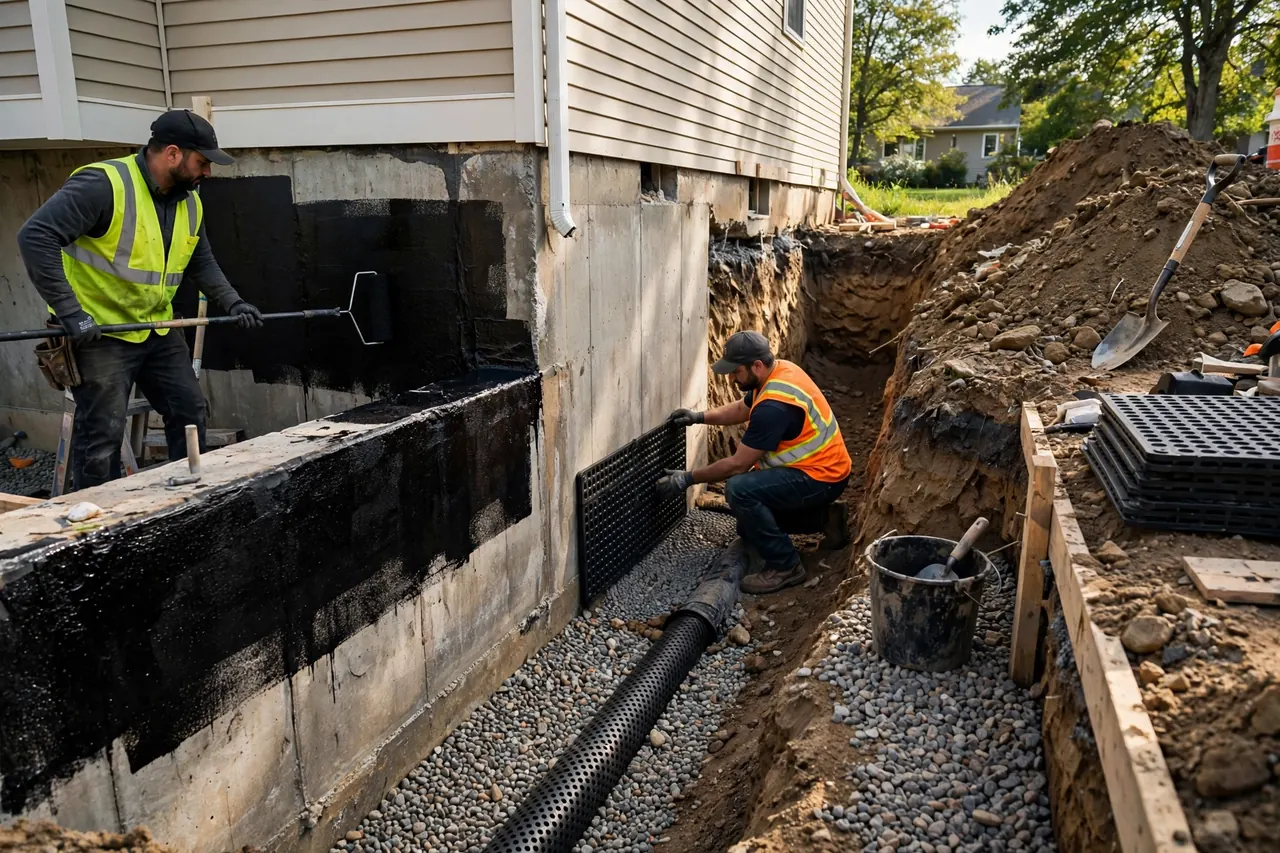
An exterior system is installed outside the foundation. The soil is dug away from the wall, the wall is sealed with a waterproof membrane, and a new exterior drain is laid at the footing.
Best for: Homes with structural wall problems that are being repaired from outside anyway, or new construction where the wall is already exposed.
Pros:
- Stops water before it touches the foundation wall
- Addresses exterior wall damage directly
Cons:
- Much more expensive, excavation, landscaping repair, and sometimes driveway or porch removal
- Disruptive: heavy equipment, torn-up yard, weeks of work
- In Ohio, you cannot dig in frozen ground, so winter scheduling is limited
- Existing exterior drains on older homes have often failed; replacing them is a big job
The combination approach
Many basements do best with a combination: fix the easy exterior problems (gutters, downspouts, grading) and install an interior system to handle the groundwater. This is the most common recommendation we make, it targets the real cause without the cost of full excavation.
Bottom line: For most Youngstown homes with water seepage, interior drainage with a reliable sump pump is the practical answer. Exterior work is the right call in specific cases, and we will tell you when yours is one of them. Fixing gutters and downspouts first often reduces the load on any system.
Benefits of Waterproofing Your Basement
- A dry, usable basement. Storage, laundry, a finished space, water stops dictating what the basement is for.
- Less mold risk. Mold needs moisture. Controlling water is the single biggest thing you can do to keep mold from growing back.
- Protects what's stored there. Furnace, water heater, washer and dryer, keepsakes, all of them last longer in dry air.
- Protects the foundation. Standing water and repeated freeze-thaw cycles wear on concrete and mortar over time.
- Home value and resale. A documented waterproofing system is a strong selling point in a market where buyers ask about basements.
What We Offer
Different water problems need different fixes. These are the services we provide across Youngstown:
- Interior drainage systems, the inside perimeter channel that catches seepage before it spreads
- Sump pump installation, the pump that moves collected water out and away
- Foundation crack repair, sealing cracks that let water through
- Crawl space waterproofing, moisture control for vented and dirt-floor crawl spaces
- Foundation repair, general methods for bowing walls and settlement
- Mold remediation, removing mold growth so moisture control can keep it away
- Egress window installation, code-compliant basement windows that let in light and air
- Basement dehumidification, controlling the damp air that remains after water is stopped
- Gutter and downspout services, the first line of defense against foundation water
Where Basement Water Actually Comes From
Water does not enter basements randomly. It uses the same entry points over and over. Knowing them helps you describe your problem accurately when you call:
- The cove joint, the seam where the basement wall meets the floor. This is the number one entry point. Hydrostatic pressure pushes water up through this joint during heavy rain.
- Wall cracks, vertical, diagonal, or stair-step cracks let water seep or stream through. Even hairline cracks can leak under pressure.
- Floor cracks, water pushes up through cracks in the concrete slab when the water table rises.
- Window wells, clogged or undrained wells fill with water and pour it through old basement windows.
- Tie-rod holes, poured concrete walls have small holes left from the metal rods used during construction. These can weep water decades later.
- Pipe penetrations, where water, sewer, or gas lines pass through the foundation wall, the seals around them fail over time.
- The top of the wall, where the wood framing meets the foundation (the sill plate area), surface water can enter if grading is poor.
- Floor drains and sewer lines, during extreme storms, municipal sewers can back up through basement floor drains. This is a different problem from groundwater seepage and needs a different solution (ask us about backwater valves).
During your inspection, we check each of these. The pattern of water entry tells us which system your basement needs.
Basement Waterproofing Methods at a Glance
Not every method fits every basement. Here is the quick map:
- Interior drainage system, for cove-joint seepage, floor cracks, and weeping block walls. Catches water inside and pumps it out. (details)
- Sump pump (new or replacement), the engine of any drainage system; also the fix when an old pump is the weak link. (details)
- Foundation crack injection, for water entering through specific cracks in poured walls. (details)
- Exterior membrane and drain, for cases where the outside of the wall needs repair; the most thorough and most expensive option.
- Gutters, downspouts, and grading, the first line of defense; sometimes the whole fix. (details)
- Dehumidification, for damp air that remains after liquid water is stopped. (details)
Most Youngstown basements end up with a combination: surface-water fixes outside plus an interior system for groundwater.
Why Basements Leak in Youngstown, OH
Youngstown basements have a few things working against them, and none of them are the homeowner's fault:
Clay soil
Much of the Mahoning Valley sits on heavy clay. Clay holds water instead of draining, so after rain or snowmelt, water sits against foundation walls and pushes in.
Freeze-thaw cycles
Ohio winters freeze the ground and spring thaws release it. Water trapped in soil expands as it freezes, pressing against walls and widening cracks year after year.
Lake-effect precipitation
The region gets heavy rain and wet snow from lake-effect weather systems. Long, wet springs and sudden summer storms are when most basements flood.
High water table
Near the Mahoning River corridor and in low-lying areas, the water table sits high. When it rises, water pushes up through floor cracks and the cove joint, this is called hydrostatic pressure.
Older housing stock
Many Youngstown homes date to the 1940s–1970s. Original drain tile is often clogged or collapsed after 50+ years, and walls develop cracks over decades.
If your home has two or three of these factors working together, a wet basement is a question of "when," not "if."
For the full picture, start with basement waterproofing in Youngstown. This service is available throughout our Youngstown-area service towns.
Why Choose Mahoning Basement Dry Co
We will be honest: you cannot verify much about a company from a website, and we will not ask you to trust claims we cannot prove. Here is what we can promise about how we work:
We specialize in basement water problems
This is all we do, drainage, pumps, cracks, and moisture, not roofing, not remodeling, not everything.
We explain options before we sell them
You will hear the interior-vs-exterior tradeoffs, the cheap fixes, and the real costs before you decide anything.
We say what we see
If your problem is a downspout issue, we will tell you to fix the downspout, not buy a drainage system.
Written scope, approved by you
No work starts until you have a clear written description of what will be done and what it costs.
Local focus
We work in Youngstown and the Mahoning Valley, the clay soil, the freeze-thaw, and the older homes here.
What affects the cost
These are typical industry estimates, not a quote from us. Every basement is different, and the final number depends on the size of the basement, the type of foundation, and the scope of the work. We will give you an exact written scope for your home before anything is scheduled.
- Foundation crack injection: commonly $300–$800 per crack
- Interior drainage system with sump pump: commonly $4,000–$12,000 for a full perimeter, depending on basement size
- Sump pump replacement (pump only): commonly $500–$2,500 installed
- Battery backup sump pump: commonly $500–$1,500 installed
- Exterior excavation and membrane: commonly $8,000–$25,000+, depending on depth and access
- Crawl space encapsulation: commonly $5,000–$15,000 depending on size and condition
Watch out for anyone who quotes a price over the phone without seeing the basement. Honest pricing requires an inspection first.
When to Call a Pro, and When You Might Not Need To
Call a waterproofing professional when:
- Water appears in the basement with every heavy rain
- You see new or growing cracks in foundation walls
- The basement smells musty no matter what you try
- A sump pump runs constantly, never runs, or is over 10 years old
- You are finishing the basement (waterproof first, finish second, always)
- You are buying a home with a wet basement and need an honest assessment
You might not need us when:
- The water appeared once after a gutter clogged, clean the gutter and watch the next storm
- A downspout broke or disconnected, reattach it and extend it away from the house
- Condensation on pipes in summer, that is humidity, not a leak; a dehumidifier may be all you need
We would rather talk you out of an unnecessary job than sell you one. Call (330) 555-0147 and describe what you are seeing, we will tell you straight which category you are in.
Serving Youngstown and 10 nearby towns
Common questions
Straight answers about basement waterproofing in Youngstown.
It depends on the scope. A single crack injection commonly runs $300–$800. A full interior drainage system with a sump pump commonly runs $4,000–$12,000. Exterior excavation commonly runs $8,000–$25,000 or more. These are typical industry estimates, not our quote, an inspection is needed for an exact number.
There is no single best method, it depends on how water enters. For most Youngstown homes, an interior drainage system with a sump pump handles hydrostatic pressure well and costs less than excavation. If the problem is one leaking crack, crack injection is the right fix. We recommend based on what your basement shows us.
Most interior drainage installations take one to three days. Crack repair is usually a single visit. We give you a schedule in writing before work starts.
Waterproofing removes the moisture that mold needs to grow, which is the most important step. If mold is already growing, it should be remediated first, then the moisture source fixed so it does not return. See our mold remediation page for more.
Most homes with water coming through the cove joint or floor need interior drainage. Exterior work is usually reserved for cases where the outside of the wall itself needs repair. During an inspection, we will tell you which one your situation calls for and why.
You can handle the surface-water side: cleaning gutters, adding downspout extensions, and improving grading are all reasonable DIY projects. Interior drainage, sump pit installation, and crack injection are professional jobs, they involve concrete cutting, correct pitch, and materials that fail if installed wrong. A failed DIY drainage system is more expensive to fix than doing it right the first time.
Generally, standard homeowners policies do not cover waterproofing as maintenance or seepage, they treat gradual water entry as a homeowner responsibility. Sudden events (like a burst pipe) are handled differently. Check your own policy and talk to your agent; we cannot advise on coverage specifics.
It varies by component. Sump pumps typically last 7–10 years and will need replacement on that cycle. A properly installed interior drainage channel has no moving parts and can function for decades, as long as the pump and discharge stay maintained. Crack injections on stable cracks generally hold. Maintenance, testing the pump, keeping the discharge clear, is what determines real-world lifespan.
A dry basement with a documented waterproofing system is a strong selling point, especially in a market like Youngstown where buyers routinely ask about basements. We cannot promise a specific dollar increase, appraisals depend on many factors, but "dry basement with drainage system" is something buyers and inspectors like to see.
Related waterproofing services
Ready to Fix Your Wet Basement?
You do not have to live with a basement that floods every spring. Call Mahoning Basement Dry Co, tell us what your basement is doing, and we will walk you through your options.