
Foundation Crack Repair in Youngstown, OH
Not all cracks leak, but certain types are far more likely to:
Signs you need this service
Not all cracks leak, but certain types are far more likely to:
Vertical cracks in poured concrete
, the most common type. They often leak during heavy rain as water follows the crack straight through the wall.
Diagonal cracks
, also common leakers, especially wider ones near corners or window openings.
Cracks with staining
, white mineral deposits (efflorescence) or rust-colored streaks around a crack mean water has been traveling through it.
Cracks that are visibly damp
, if the crack feels wet or you see droplets after rain, it is an active leak path.
Cracks in block walls (stair-step pattern)
, water can travel through the hollow cores of concrete blocks and appear far from the actual entry point.
Horizontal cracks
running along the length of a wall, these can indicate pressure from soil pushing the wall inward
Wide cracks
(wider than about 1/4 inch) that are growing
Cracks with displacement
, one side of the crack is pushed in or out relative to the other
Bowing or leaning walls
with cracking
We are a waterproofing company, not engineers. We seal cracks that leak. We do not declare foundations structurally sound, if a crack looks structural, we will tell you to get a structural engineer's evaluation before any repair work. That is the honest order of operations, and skipping it helps no one.
What’s included
Depending on the crack and the wall type, repair may include:
- Inspection and measurement , crack type, width, length, and whether it is active (growing) or stable
- Surface preparation , cleaning the crack and surrounding wall so sealants bond properly
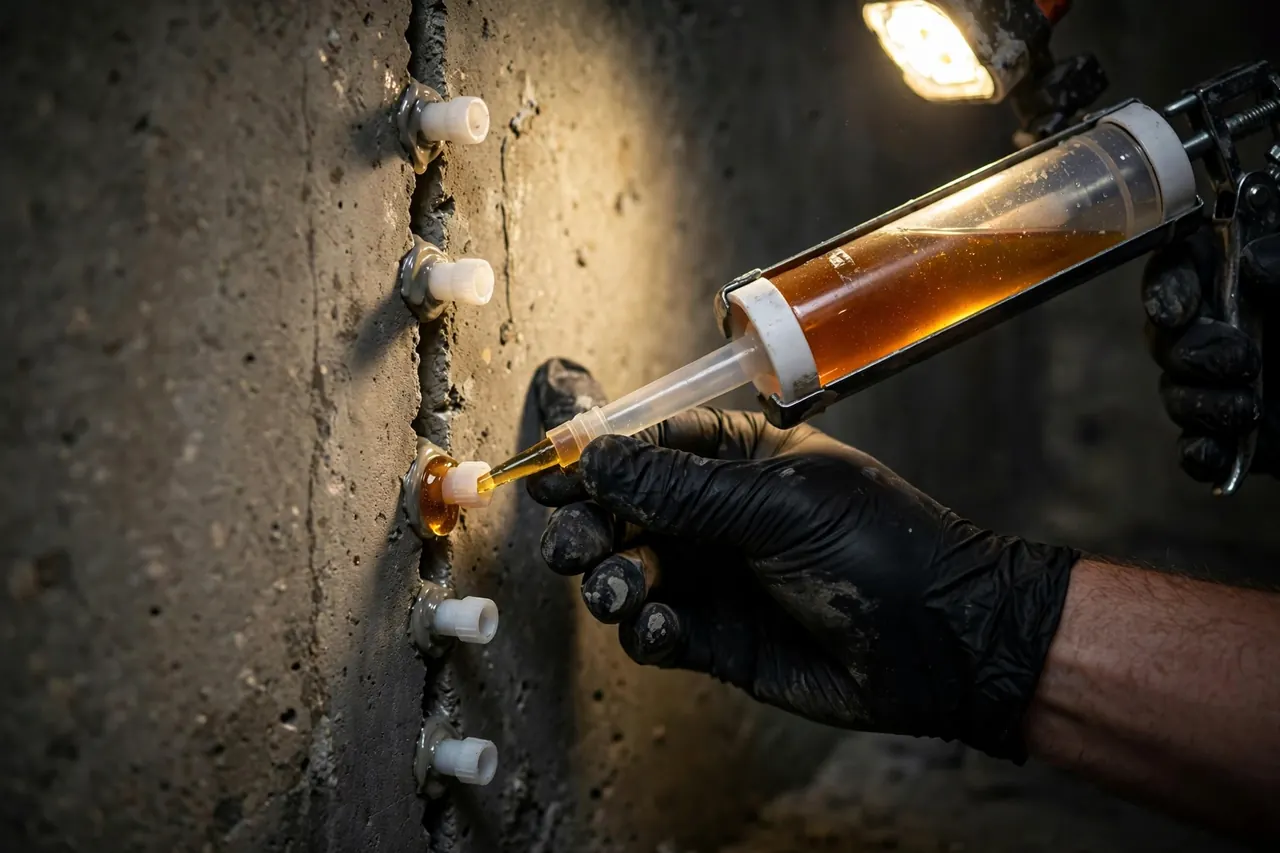
- Injection (epoxy or polyurethane) , filling the crack from inside the wall outward
- Exterior patching , where accessible, sealing the outside face of the crack
- Carbon fiber staples or stitching , for cracks that need reinforcement against reopening (cosmetic/structural support, not a structural certification)
- Water testing , confirming the seal holds under water exposure
How the work goes
You call (330) 555-0147 and describe the crack
Where is it? How long? Does it leak, and when? A photo helps enormously.
Inspection
We examine the crack's type, width, and pattern, and check whether it is active or stable. If it looks structural, we stop here and recommend a structural engineer.
Recommendation
We explain the repair method that fits, usually polyurethane or epoxy injection, and why.
Written scope and price
You approve the exact work and cost before we schedule.
Repair visit
Most crack injections take a few hours. Ports are set, material is injected, and the surface is finished.
Verification
We confirm the seal and explain what to watch for, including when to call us back.
Timeline Expectations
- Inspection: one visit; we measure and classify the crack on the spot
- Single injection: a few hours, usually scheduled within days of approval
- Multiple cracks: often completed in the same visit
- Exterior repair: a day or more depending on depth and access; weather-dependent in winter
- If an engineer is needed: add time for their evaluation before any repair is scheduled, this is the correct order, not a delay
Epoxy vs. Polyurethane Injection: What's the Difference?
Injection is the standard repair for leaking cracks in poured concrete walls. A two-part material is injected under pressure into the crack, filling it from the inside out. But the two main materials do different jobs:
Polyurethane injection
- Flexible. It stays slightly flexible after curing, so it moves with the wall through freeze-thaw cycles without cracking.
- Expands to fill. It foams and expands inside the crack, sealing irregular voids and small branches off the main crack.
- Best for: Cracks that leak water. This is the go-to material for stopping active leaks because it reacts with water and seals even in wet conditions.
- Limitation: It does not restore the wall's original structural strength, it seals against water.
Epoxy injection
- Rigid and strong. It cures hard and bonds the two sides of the crack together, restoring much of the wall's original strength across the crack.
- Does not expand. It fills exactly the space injected, so the crack must be clean and accessible.
- Best for: Non-leaking cracks where the goal is bonding the concrete back together.
- Limitation: Because it is rigid, it can crack again if the wall moves, and it cannot be injected into an actively leaking crack effectively.
In plain terms: leaking crack → polyurethane. Non-leaking crack that needs bonding → epoxy. A reputable contractor explains which one your crack needs and why, not just which one they prefer to sell.
Can Foundation Cracks Be Repaired From Inside?
Yes, most leaking cracks in poured concrete walls are repaired from inside the basement. Injection ports are placed along the crack, the material is injected under pressure, and the crack is sealed full-depth through the wall. No digging required.
There are exceptions:
- Block wall cracks sometimes need exterior work, because water travels through the hollow block cores in ways interior injection cannot fully reach.
- Cracks behind finished walls require opening the wall to access them.
- Exterior-only access is needed when the inside of the wall is not reachable.
Interior injection is less expensive, less disruptive, and effective for the most common crack type (vertical cracks in poured walls). We will tell you during inspection whether your crack qualifies.
Benefits of Repairing Foundation Cracks
- Stops the leak. A properly injected crack stops water at its entry point instead of letting it find new paths.
- Prevents freeze-thaw damage. Water inside a crack expands when it freezes, widening the crack each winter. Sealing it breaks the cycle.
- Reduces mold risk. Every leak is a moisture source. Fewer leaks means less mold food.
- Protects finished basements. If you ever finish the basement, sealed cracks are non-negotiable, drywall hides leaks until they become disasters.
- Documents the repair. A written record of professional crack repair matters at resale, buyers and inspectors ask about foundation cracks.
Crack Types: A Homeowner's Field Guide
Foundation cracks have names, and the name tells you a lot. Walk your basement with a flashlight and compare:
Vertical cracks
Straight up-and-down cracks in poured concrete walls. The most common type by far, usually caused by concrete shrinkage as it cured, or minor settlement. Thin vertical cracks (hairline to 1/8 inch) that are not growing are typically the least concerning structurally, but they are also the most common leakers. Leak likelihood: high during heavy rain.
Diagonal cracks
Cracks running at an angle, often starting near corners, window openings, or where the wall steps down. Usually indicate differential settlement, one part of the foundation settled more than the adjacent part. Leak likelihood: moderate to high, especially wider ones.
Horizontal cracks
Cracks running sideways along the wall, often at or below the frost line or mid-wall. These are the ones that deserve respect, they can indicate lateral soil pressure pushing the wall inward. Do not just seal these. Get a structural engineer's evaluation first. See foundation repair.
Stair-step cracks
Zigzag cracks following the mortar joints in concrete block walls. Caused by settlement or lateral pressure. Water travels through the hollow block cores, so the leak can appear far from where water actually enters. Leak likelihood: high, and tricky to trace.
Hairline / shrinkage cracks
Very thin surface cracks, often in a spiderweb or map pattern, from concrete curing. Usually do not go through the full wall thickness and often do not leak. Leak likelihood: low, but monitor them.
Cracks with displacement
Any crack where one side has shifted relative to the other, in, out, up, or down. This is movement, not shrinkage. Engineer first, always.
How to tell if a crack is active (growing): Mark both ends with a pencil and date it. Measure the width with a ruler. Check again in a few months, especially after winter. A crack monitor, a small inexpensive gauge glued across the crack, gives you precise readings. Growing cracks need professional evaluation before any sealing.
All Crack Repair Methods: Honest Pros and Cons
Polyurethane injection
The standard for leaking cracks in poured walls. Injected under low pressure, it expands to fill the crack and its branches, curing into a flexible seal.
Pros: seals active leaks; flexible through freeze-thaw; no excavation. Cons: does not restore structural strength; not ideal for wide or structural cracks.
Epoxy injection
Injected under higher pressure, it bonds the concrete back together with a rigid, high-strength fill.
Pros: restores much of the wall's strength across the crack; long-lasting on stable cracks. Cons: cannot be injected into an actively leaking crack; rigid, so it can re-crack if the wall keeps moving.
Exterior excavation and patching
A section outside the wall is dug out, the crack is sealed from the outside with membrane or hydraulic cement, and a drainage board may be added.
Pros: addresses the crack from the water's side; allows inspection of exterior wall condition. Cons: expensive; disruptive; limited by frozen ground in winter.
Hydraulic cement patching
A fast-setting cement pressed into the crack from inside.
Pros: cheap and fast; stops minor seepage temporarily. Cons: rigid and brittle, it typically cracks again with the next freeze-thaw cycle. We consider this a temporary patch, not a repair. Be skeptical of anyone selling it as a lasting fix.
Carbon fiber staples / stitching
Carbon fiber strips or steel staples are bonded across the crack to hold it together and resist reopening.
Pros: adds reinforcement against the crack widening; good companion to injection. Cons: does not seal water by itself (pair it with injection); surface-mounted, so visible on the wall.
What we actually recommend
For a leaking vertical crack in a poured wall: polyurethane injection, full stop, it is the right material for the job. For a non-leaking crack that needs bonding: epoxy. For anything horizontal, displaced, or growing: an engineer before anything else. If a contractor recommends the same method for every crack, get a second opinion.
Why Foundation Cracks Are Common in Youngstown
Freeze-thaw cycles
Ohio winters are the main culprit. Water in soil freezes and expands against foundation walls, then thaws and releases. Decades of this cycle stress concrete and open cracks, especially in poured walls from the 1950s–1970s building boom.
Clay soil pressure
Youngstown's clay holds water instead of draining. Saturated clay is heavy, and it presses against foundation walls with far more force than sandy soil. That lateral pressure opens cracks over time.
Settlement
All houses settle. Most settlement is harmless and creates thin vertical "shrinkage" cracks. But uneven settlement, common where soil conditions vary across a lot, creates the diagonal and stair-step cracks that leak.
Age
Many Mahoning Valley homes are 50–80 years old. Concrete cures, shrinks, and ages. A crack in a 60-year-old wall is often just the wall showing its age, but it still needs sealing if it leaks.
Homeowners in Canfield and Poland with larger lots sometimes see settlement cracks from varied soil across the property. In Warren and Campbell, older housing stock means age-related cracking is simply common.
For the full picture, start with basement waterproofing in Youngstown. This service is available throughout our Youngstown-area service towns.
Why Choose Mahoning Basement Dry Co
We tell you when it is not our job
If a crack looks structural, we say so and point you to a structural engineer. We would rather lose the job than seal a crack that needs engineering.
We match the material to the crack
Polyurethane for leaks, epoxy for bonding, explained in plain language, not upsold.
Waterproofing is all we do
Crack repair is part of our core work, not a side service.
Written scope, clear price
You approve the method and the cost before we schedule the visit.
Local walls, local knowledge
We work on Youngstown-area poured and block foundations regularly and know their typical crack patterns.
What affects the cost
These are typical industry estimates, not a quote from us:
- Single crack injection (polyurethane or epoxy): commonly $300–$800 per crack
- Multiple cracks: commonly $250–$600 per additional crack when done in the same visit
- Exterior crack repair (excavation of a small section): commonly $1,000–$3,000 depending on depth and access
- Carbon fiber staples/stitching: commonly $400–$800 per crack, in addition to injection
What affects the price: crack length and width, wall type (poured vs. block), accessibility, and whether water is actively flowing during the repair. Be wary of anyone who quotes per-crack pricing without measuring the crack.
When to Call a Pro, and When to Watch and Wait
Call now when:
- Water is actively coming through a crack
- A crack is wider than about 1/4 inch
- A crack is growing (your pencil marks moved)
- The crack is horizontal or stair-step with displacement
- Multiple new cracks appeared after a wet season
Watch and wait (with monitoring) when:
- A hairline vertical crack is dry, stable, and not growing, mark it, date it, check it seasonally
- Old repaired cracks show no new moisture
Call a structural engineer first when:
- Horizontal cracking, bowing, or wall displacement is present
- Cracks are growing despite no obvious water cause
- Doors and windows are sticking along with the cracking
We seal leaks. Engineers assess structures. Knowing which one you need saves you from paying for the wrong one. Call (330) 555-0147 and we will help you sort it out.
Serving Youngstown and 10 nearby towns
Common questions
Straight answers about foundation crack repair in Youngstown.
Vertical and diagonal cracks in poured concrete are the most common leakers. Stair-step cracks in block walls also leak, with water traveling through the hollow cores. Any crack with staining or dampness around it is an active leak path.
Yes, most vertical cracks in poured walls are sealed with interior injection, no digging needed. Block wall cracks and inaccessible cracks are the main exceptions.
Polyurethane is flexible and expands, best for stopping active water leaks. Epoxy cures rigid and bonds concrete, best for non-leaking cracks that need strength restored. Your crack type decides which one fits.
Most single-crack injections are completed in a few hours during one visit. You do not need to leave the house.
A properly injected stable crack generally stays sealed. If the wall keeps moving, ongoing settlement or soil pressure, a new crack can form nearby. That is why we check whether a crack is active or stable before repairing it.
Most thin vertical cracks are shrinkage or minor settlement and are repairable. Horizontal cracks, wide growing cracks, and bowing walls deserve a structural engineer's evaluation. When in doubt, get it looked at, worry is more expensive than an inspection.
Hardware-store hydraulic cement or caulk can slow a minor seep temporarily, but these are surface patches, they do not fill the crack through the wall, and they typically fail within a season or two of freeze-thaw. Injection requires ports, pressure equipment, and the right material for the crack type. For a crack that actually leaks, professional injection is the fix that holds.
Typical industry estimates: $300–$800 per crack for injection, less per crack when several are done in one visit. Exterior repairs run $1,000–$3,000+. These are estimates, not quotes, crack length, width, wall type, and access all move the number.
Not urgently, but monitor it. A dry, stable hairline crack can sit for years. The reasons to seal a non-leaking crack: you are finishing the basement (drywall hides future leaks), the crack is growing, or you want it documented before a sale. Water in a crack also expands when it freezes, so today's dry crack can become tomorrow's leak.
Possibly, repairing one crack does not change the soil, water pressure, or settlement affecting the wall. New cracks nearby usually mean the underlying cause (water pressure, soil movement) is still active. That is worth investigating rather than just sealing each new crack as it appears.
Related waterproofing services
Get Your Crack Looked At
A leaking crack will not seal itself, and every freeze-thaw cycle can make it worse. Call Mahoning Basement Dry Co, describe the crack or send a photo, and we will tell you honestly what you are dealing with. If it is a straightforward leak, we will seal it. If it needs an engineer, we will tell you that too.
Call today.