
How Does a Sump Pump System Actually Work?
Here is each part, what it does, and what can go wrong.
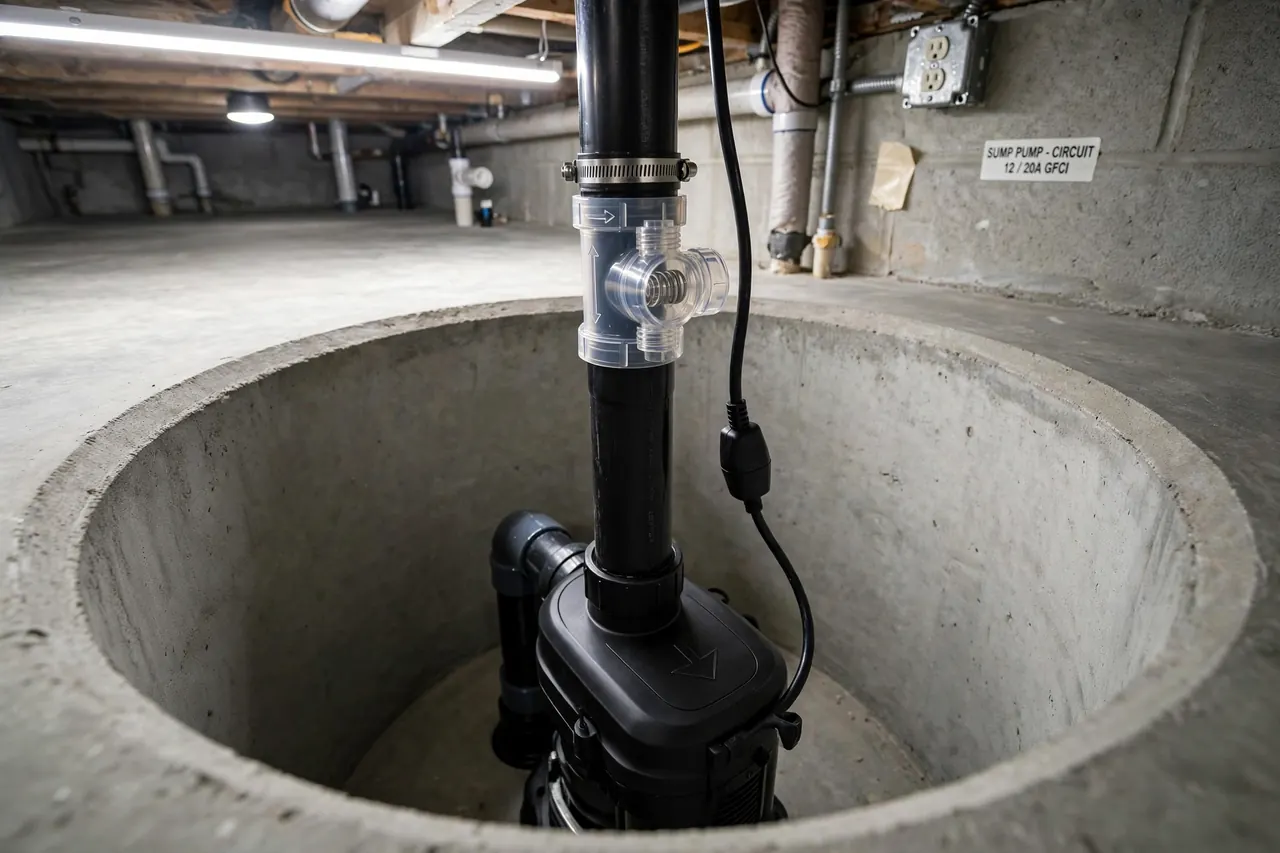
Direct answer: A sump pump sits in a pit at the lowest point of your basement. Water flows into the pit through drain pipes, and when the water rises to a set level, a float switch turns the pump on. The pump pushes the water up a discharge pipe and out away from your house. When the water drops, the float switch turns the pump off. That is the whole cycle, repeated automatically.
Here is each part, what it does, and what can go wrong.
The Parts of the System
1. The Sump Pit
A round pit, usually 18–24 inches wide and 2–3 feet deep, dug into the basement floor at the low point. Water collects here first. If you have an interior drainage system, the perimeter drain pipe empties directly into this pit.
2. The Pump
The pump sits inside the pit. Two common types:
- Submersible pumps sit in the water. They are quieter, handle more water, and last longer. This is what most pros install.
- Pedestal pumps have the motor mounted above the pit on a column. They are cheaper and easier to service, but noisier and less powerful.
3. The Float Switch
This is the "brain" of the operation. It is a floating ball or vertical switch that rises with the water. When water reaches the trigger level, the switch clicks on. When pumping lowers the water, it clicks off.
Most sump pump failures are really float switch failures, the switch gets stuck on debris, tangled in the cord, or just wears out.
4. The Discharge Pipe
The pipe carries water up and out of your basement. It should discharge at least 10–20 feet from your foundation, pumping water next to the house just sends it back into the pit.
A check valve on the pipe keeps water from flowing back down into the pit when the pump shuts off. Without it, the pump cycles constantly and wears out early.
The Full Cycle, Step by Step
- Rain or groundwater seeps toward your foundation.
- Perimeter drains (or natural flow) carry water into the sump pit.
- Water level rises. The float switch triggers.
- The pump pushes water up the discharge pipe and outside.
- Water level drops. The float switch shuts the pump off.
- The system waits for the next cycle.
During a heavy Youngstown storm, this cycle can repeat every minute or two. That is normal, it means the system is working.
What Happens When the Power Goes Out?
This is the most important question. Storms that bring flooding rain also knock out power. A standard sump pump does not work without electricity.
That is why many homeowners add a battery backup sump pump. It is a second pump on a marine-style battery that kicks in automatically when the main pump loses power or fails. In the Mahoning Valley, where spring storms and winter outages are routine, backup pumps are less of a luxury and more of a necessity.
There are also water-powered backup pumps that run on municipal water pressure, no battery to maintain. They work only if you have city water (not a well) and strong enough pressure.
Signs Your Sump Pump Is Failing
- It runs constantly even in dry weather (stuck float switch)
- It never turns on when the pit fills (dead pump or switch)
- Strange grinding or rattling noises
- It is more than 7–10 years old, most pumps wear out in that range
- The pit has no check valve or discharges too close to the house
Test yours right now: pour a bucket of water into the pit. The pump should kick on, drain the pit, and shut off. If it does not, it needs attention. Also check that the discharge pipe outside is not frozen, crushed, or buried, a blocked discharge is one of the most common reasons a working pump still leaves a wet basement.
How a Sump Pump Fits the Bigger Picture
A sump pump alone does not waterproof a basement. It is the exit, water still needs a path to reach it. That is why pumps are usually installed as part of an interior drainage system. The drain collects the water; the pump removes it.
Upgrades that make the whole setup stronger:
- Battery backup pump for outages
- Sealed pit lid to keep out radon, moisture, and debris
- High-water alarm that alerts you if the pit overfills
Sizing: How Much Pump Do You Need?
Sump pumps come in different power levels, usually measured in horsepower (HP), common residential sizes are 1/3 HP, 1/2 HP, and 3/4 HP. They are also rated in gallons per hour (GPH): how much water they can move.
Bigger is not automatically better. An oversized pump cycles on and off constantly (called "short cycling"), which wears out the float switch early. An undersized pump cannot keep up in a heavy storm and lets the pit overflow.
What actually determines the right size:
- How much water your pit collects. A basement that takes on heavy seepage needs more capacity than one that gets occasional dampness.
- How high the water must be lifted. Pumping up 8 feet of head to reach the discharge point takes more power than 4 feet.
- How far the discharge runs. Long horizontal runs add resistance the pump must overcome.
A professional sizes the pump to your home's actual water load, not to a guess. If a quote does not mention pump size at all, ask.
Battery Backup Systems in Detail
A battery backup is a second, DC-powered pump that sits in the same pit and takes over automatically when the main pump loses power or fails. Here is what to know:
How long does the battery last? It depends on the battery size and how hard the pump works. A typical setup runs intermittently for several hours, enough to ride out most outages. In a severe storm with constant inflow, runtime is shorter. Bigger batteries and dual-battery setups extend it.
What maintenance does the battery need? Batteries age whether you use them or not. Check the battery's charge indicator regularly, keep terminals clean, and plan on replacing the battery every 3–5 years. A dead backup battery is the same as no backup at all, test the whole system, not just the main pump.
What about water-powered backups? These run on municipal water pressure instead of a battery, no battery to replace, and they run as long as your water supply holds. The catch: they only work with city water (not a well), they need strong water pressure, and they use a meaningful amount of water while running. They are also slower than electric pumps, so they are a backup, not a primary.
Do I really need one? In the Mahoning Valley, spring storms and winter weather knock out power regularly, often during the exact storms that flood basements. If your basement has ever taken water, a backup pump is one of the highest-value upgrades you can buy.
Your Yearly Sump Pump Maintenance Calendar
Spring: Test the pump before storm season, pour a bucket of water in the pit and watch the full cycle. Clear the discharge outlet outside. Check the check valve.
Summer: Quick visual check monthly. Make sure the pit is free of debris and the float switch moves freely.
Fall: Test again before winter. Make sure the discharge line will not freeze, it should slope so water drains out completely between cycles.
Winter: Listen during thaws. If the pump runs during a January thaw, the discharge may be icing up outside, check that water is actually leaving the pipe.
Year-round: If you have a battery backup, glance at the charge indicator monthly. Replace the battery on schedule, not when it fails.
Fifteen minutes a few times a year is the difference between a pump that works when you need it and a nasty surprise.
High-Water Alarms: Cheap Insurance
A high-water alarm is a small device that sits in the pit above the normal trigger level. If water rises past it, meaning the pump is not keeping up, it sounds an alarm (some models send phone alerts).
They cost little and install in minutes. If your basement is finished, or if you travel, an alarm turns a potential flood into a warning you can act on. It is the simplest upgrade on this list.
Frequently Asked Questions
How often should a sump pump run? Only when there is water to pump. Running occasionally after rain is normal. Running every few minutes in dry weather means a stuck switch or groundwater problem.
Can I install a sump pump myself? Digging the pit, tying in drains, and wiring the pump is real work. Many homeowners hire a pro for the installation and handle maintenance (testing, cleaning the pit) themselves.
Where should the discharge water go? Away from the house, never into your neighbor's yard, and check local rules about discharging into storm drains or the street.
Why does my pump run even when it hasn't rained? Groundwater does not follow the weather forecast. A high water table can keep a pit filling for days after rain stops. But if it runs constantly in a dry spell with no water in the pit, the float switch is probably stuck.
How long do sump pumps last? Most last 7–10 years. Cheap pumps and pumps that short-cycle wear out faster. When you replace one, replace the check valve too, it is inexpensive and wears on the same timeline.
Should the pit have a lid? Yes, a sealed lid keeps out debris, reduces humidity and radon entry, quiets the pump, and keeps small objects (and curious kids or pets) out of the pit.
Can a sump pump handle a finished basement? Yes, and finished basements are exactly where you want the most reliable setup: quality primary pump, battery backup, and a high-water alarm. The cost of a flood in a finished basement dwarfs the cost of the equipment.
What is the number one cause of sump pump failure? Loss of power during a storm, which is why battery backup exists. After that: stuck or failed float switches, clogged or frozen discharge lines, and pumps that simply aged out.
The Bottom Line
A sump pump is simple: water rises, switch flips, pump pushes water out. The failures happen in the details, bad float switches, missing check valves, short discharge lines, and no backup when the power dies.
If your pump is old, noisy, or untested, do not wait for a storm to find out. Call (330) 555-0147 and we will check your whole setup, pump, pit, discharge, and backup, so it is ready when the water comes.
Internal links: Sump Pump Installation in Youngstown, OH · Interior Drainage Systems · Basement Waterproofing in Youngstown, OH
Water in your Youngstown basement?
Call now, tell us what your basement is doing, and we’ll walk you through your options. No pressure.