
Foundation Cracks: Which Ones Leak and Which Don't
Here is how to read what your walls are telling you.
Direct answer: Vertical hairline cracks in poured concrete are the most common leakers, they are usually shrinkage cracks and often just need sealing. Horizontal cracks and widening stair-step cracks are the ones to take seriously: they signal pressure or movement, and they need a structural engineer's opinion before any repair. Not every crack is an emergency, but every leaking crack deserves attention.
Here is how to read what your walls are telling you.
Vertical Cracks
Look: A mostly straight line running up and down (or slightly diagonal) on the wall.
Common cause: Concrete shrinks as it cures. This shrinkage cracks the wall, usually within the first few years of the home's life. It is the most common crack in poured concrete foundations.
Do they leak? Yes, often. Even a hairline vertical crack is a direct path for water. The good news: these are the cracks most straightforwardly repaired, typically with injection from the inside.
Watch for: If a vertical crack widens over time or starts leaking more heavily, something is changing. Note the date and check it again after the next big rain.
Horizontal Cracks
Look: A line running sideways along the wall, often at or below the frost line.
Common cause: Soil pressure pushing against the wall from outside. Youngstown's clay soil expands when wet and presses hard against foundations, a classic cause of horizontal cracking.
Do they leak? They can, but leaking is not the main concern here. A horizontal crack suggests the wall is under serious lateral pressure.
Action required: Get a structural engineer to look at it. This is not just a waterproofing issue. No one should declare a foundation "safe" from a visual check, an engineer determines whether the wall needs bracing, anchors, or other structural repair. Waterproofing comes after the wall is stabilized.
Stair-Step Cracks (Block Walls)
Look: Cracks that zigzag through the mortar joints of a concrete block wall, like stairs.
Common cause: Settlement or pressure on a block foundation. Older Mahoning Valley homes often have block foundations, and these cracks are a familiar sight in them.
Do they leak? Frequently, water follows the mortar joints. Seepage through stair-step cracks is a common complaint in older block basements.
Action required: Minor stair-step cracking with no wall movement may be a waterproofing fix. But if the wall bows inward or the steps are widening, get a structural engineer involved. Bowing block walls are a structural matter.
Diagonal Cracks
Look: A crack running at roughly 45 degrees, often from a corner of a window or door opening.
Common cause: Differential settlement, one part of the foundation sinking slightly more than another.
Do they leak? They can, especially wider ones. Narrow diagonal cracks near openings are often minor. Wider ones, or several appearing at once, point to settlement worth investigating.
Action required: Monitor. Mark the ends with a pencil and date it. If it grows, talk to a professional, and an engineer if the movement seems active.
Hairline Cracks (Non-Leaking)
Look: Very thin surface cracks, often like spiderwebs, that stay dry through rain.
Do they leak? Not currently. They are usually surface shrinkage and cosmetic.
Action required: Watch them. Many never cause trouble. If one starts leaking, it moves into the vertical-crack category above.
A Quick Crack Reference
| Crack type | Typically leaks? | Main concern | Next step | |---|---|---|---| | Vertical hairline | Often | Water entry | Monitor or inject | | Horizontal | Sometimes | Structural pressure | Structural engineer | | Stair-step (block) | Often | Water + possible movement | Inspect; engineer if bowing | | Diagonal | Sometimes | Settlement | Monitor; engineer if growing | | Hairline surface | No | Cosmetic | Watch |
How Cracks Get Repaired
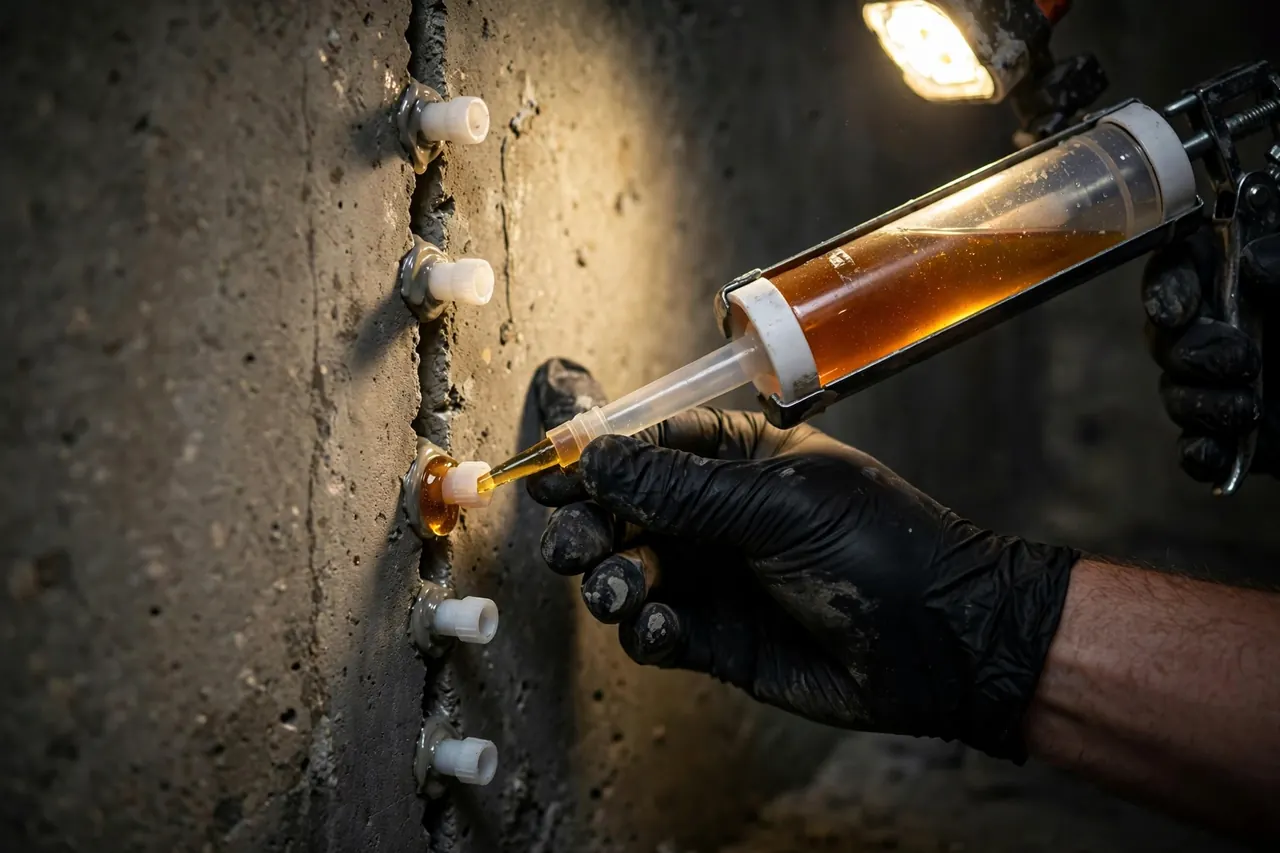
For non-structural leaking cracks, the standard fix is injection, epoxy or polyurethane is injected into the crack from inside the basement, filling it completely and bonding it shut. It is a same-day job in most cases.
For structural cracks, repair starts with stabilizing the wall (bracing, anchors, or wall systems, designed by an engineer), and injection or waterproofing follows. Never let anyone just caulk a horizontal crack and call it fixed.
The Ohio Factor: Freeze-Thaw
Youngstown winters are rough on cracks. Water seeps into a small crack, freezes, expands, and widens the crack, every winter, a little more. A hairline crack that was "fine" for years can start leaking after a few freeze-thaw seasons. Fall is the smart time to address cracks, before winter gets to work on them.
How to Monitor a Crack Like a Pro
Most cracks do not need immediate repair, but all of them deserve monitoring. Here is a simple system:
- Mark it. Draw a short pencil line across the crack at each end, and write the date beside it. Pencil, not pen, you want to add to it over time.
- Photograph it. Take a close-up with a coin or ruler for scale, plus a wider shot showing where it is on the wall. Save with the date.
- Measure it. A crack width gauge is cheap, but a simple ruler works. Note the width at the widest point in millimeters or sixteenths of an inch.
- Recheck after big events. After the next heavy rain, after winter thaw, and once each fall, compare against your marks.
- Log changes. A crack that grows 1mm in a year is worth watching. One that grows 3mm in a month deserves a professional look.
This log is also valuable if you ever sell the house, it shows buyers (and their inspectors) that the crack is stable and monitored, not ignored.
When monitoring becomes action: growth over consecutive checks, new leaking where it was dry, fresh crumbling at the crack edges, or any horizontal cracking. Do not wait for a "big" change, trends matter more than single measurements.
Youngstown Foundation Types: What You Are Likely Looking At
The Mahoning Valley's housing stock gives you three common foundation types, and cracks behave differently in each:
Poured concrete (common from the 1950s on): Strong, monolithic walls. Cracks are usually vertical shrinkage cracks, the classic leakers, and the most straightforward to inject and seal.
Concrete block (common in pre-1960s homes): Walls built from stacked blocks with mortar joints. Cracks follow the mortar in stair-step patterns. Block walls are more vulnerable to water because the hollow cores can fill and the mortar deteriorates, and to pressure, because the wall is only as strong as its joints.
Stone foundations (oldest homes, 1900s and earlier): Irregular stone with mortar. These leak through countless small paths rather than single cracks. Waterproofing a stone foundation is a different job, usually interior drainage rather than crack injection, since there is no single crack to seal.
Knowing your foundation type tells you which repair methods even apply. A contractor should identify it during inspection, ask if they do not mention it.
What a Structural Engineer Actually Does
"See a structural engineer" sounds intimidating. Here is what it actually involves:
- Visual inspection of the wall, inside and out, looking for bowing, displacement, crack patterns, and signs of movement.
- Measurements of any bowing or leaning, compared against tolerances.
- Assessment of cause, soil pressure, settlement, water, or a combination.
- Written findings with recommendations: monitor, brace, anchor, or rebuild.
An engineer's report typically costs a few hundred dollars, a fraction of any structural repair, and it protects you from paying for the wrong fix. Crucially, an engineer has no financial interest in selling you a repair. Their job is diagnosis, not sales.
When you definitely need one: horizontal cracks, bowing or leaning walls, stair-step cracks that are widening, or any crack a waterproofing contractor says is "probably fine" but cannot explain. When in doubt, the engineer's fee is cheap insurance.
Repair Methods Compared
Epoxy or polyurethane injection (interior): The standard fix for non-structural leaking cracks. Ports are set along the crack, material is injected under pressure, and it fills the crack completely, bonding it shut through the full thickness of the wall. Usually a same-day job. Polyurethane stays slightly flexible, which helps it survive minor future movement.
Exterior excavation and sealing: The wall is dug out, the crack is sealed from outside, and a membrane is applied. More thorough for badly deteriorated areas, but far more expensive, usually reserved for structural situations or when excavation is happening anyway.
Carbon fiber straps or wall anchors (structural): For bowing or moving walls, these stabilize the wall against further movement. Designed or approved by an engineer. This is structural repair, not waterproofing, though waterproofing usually follows.
What never works: surface caulk, hydraulic cement smeared over the face, or paint. These cover the crack's surface while water keeps moving behind it. The crack will leak again, usually by the next wet season.
Frequently Asked Questions
Can foundation cracks be repaired from the inside? Yes, most non-structural cracks are injected from inside the basement, with no digging. Structural cracks need more.
Will a repaired crack leak again? Injection done properly seals the crack itself. But it does not fix the water pressure behind the wall, if hydrostatic pressure is the cause, a drainage system may be needed alongside the repair.
Should I worry about a crack that doesn't leak? Monitor it. Dry cracks can stay harmless for years, or start leaking after the next freeze-thaw cycle. A dated photo makes changes easy to spot.
Can I just fill a leaking crack with caulk from the hardware store? It will fail. Surface caulk does not penetrate the crack, and water pressure pushes it off from behind. Proper injection fills the full depth of the wall, that is why it holds and caulk does not.
How much does crack injection cost? As a general estimate, a single non-structural crack injection often runs $500–$1,000. Multiple cracks or difficult access can push it higher. These are estimates, not quotes, an inspection determines the real number.
Will fixing one crack stop water from finding another way in? Injection seals that crack completely. But if hydrostatic pressure is pushing water against the whole wall, sealing one crack can redirect water to the next weakest point. That is why contractors often recommend a drainage system alongside crack repair for chronic seepage.
My block wall leaks through the mortar joints, not a single crack. What then? That is common with older block foundations. Options include interior drainage to manage the water, sealing the interior wall surface, or exterior work for severe deterioration. An inspection determines which fits, block walls rarely have a single "fix this crack" answer.
The Bottom Line
Vertical hairline cracks are the classic leakers and usually the simplest to fix. Horizontal and widening stair-step cracks are the ones that need a structural engineer, no one should guess about wall stability.
See a crack in your basement? Call (330) 555-0147 for an inspection. We will tell you which kind you are looking at and what your options are, and we will point you to an engineer when that is what the crack calls for.
Internal links: Foundation Crack Repair in Youngstown, OH · Foundation Repair · Basement Waterproofing in Youngstown, OH
Water in your Youngstown basement?
Call now, tell us what your basement is doing, and we’ll walk you through your options. No pressure.